Basic Information
Product name | JC-1 Mitochondrial Membrane Potential Assay Kit |
Size | 20T/100T |
Storage | -20℃, away from light. Component B can also be stored at 4℃. To avoid repeated freezing and thawing, it is recommended to devide components A and C into small packages. |
Shipping | Shipped with ice pack |
Validity | 12 months |
JC-1 excitation /emission wavelength(Low Membrane Potential) : 485/535 nm
JC-1 excitation /emission wavelength(High Membrane Potential) : 550/600 nm
Product Composition
Components | 20T | 100T |
A :JC-1,100×in DMSO | 100μL | 500μL |
B: 10×Assay Buffer | 5mL | 25mL |
C: CCCP, 50mM | 10μL | 50μL |
Product Introduction
A decrease in mitochondrial membrane potential is a sign of early apoptosis, which occurs before the externalization of phosphatidylserine on the cell membrane and the activation of caspase hydrolases. When the mitochondrial membrane permeability changes, the membrane potential decreases. This change in membrane potential is caused by the formation of Bax dimers and the activation of Bid, Bak, and Bad, which induce the formation of pores in the mitochondrial membrane. When these pro-apoptotic proteins are activated, mitochondria also release cytochrome C into the cytoplasm.
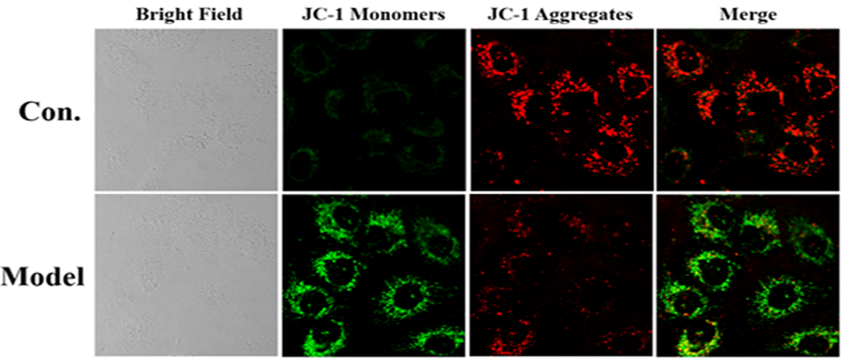
JC-1 is an ideal fluorescent probe widely used to detect mitochondrial membrane potential △Ψm. It can detect the mitochondrial membrane potential of cells, tissues or purified mitochondria. When the mitochondrial membrane potential is high, JC-1 aggregates in the matrix of mitochondria to form polymers and produce red fluorescence; when the mitochondrial membrane potential is low, JC-1 cannot aggregate in the matrix of mitochondria. At this time, JC-1 is a monomer and can produce green fluorescence. The decrease in membrane potential can be easily detected by the transition of JC-1 from red fluorescence to green fluorescence. At the same time, the transition of JC-1 from red fluorescence to green fluorescence can also be used as an indicator for the early detection of cell apoptosis.
The maximum excitation wavelength of JC-1 monomer is 510nm, and the maximum emission wavelength is 527nm; the maximum excitation wavelength of JC-1 polymer is 585 nm, and the maximum emission wavelength is 590nm. This kit is simple and fast to operate, and can be detected by flow cytometry, fluorescence microscopy or fluorescence microplate reader. CCCP is also provided as a positive control for inducing a decrease in mitochondrial membrane potential.
Note
1. All fluorescent dyes have quenching problems. Please try to avoid light to slow down fluorescence quenching.
2. To avoid repeated freezing and thawing, this product can be repacked into small quantities.
3. Before use, please centrifuge the product to the bottom of the tube and then proceed with subsequent experiments.
4. JC-1 (100× in DMSO) will solidify and stick to the bottom, wall or lid of the centrifuge tube at a lower temperature. It can be incubated in a 20-25℃ water bath for a while until it is completely melted before use.
5. When preparing the JC-1 staining working solution, you must first fully dissolve the JC-1 (100× in DMSO) provided in the kit with sterile diH2O and then add the 10× Assay Buffer. Do not prepare the 1× Assay Buffer first and then add JC-1 (100× in DMSO), as this will make it difficult for JC-1 to fully dissolve, which will seriously affect subsequent detection.
6. When washing with 1× Assay Buffer after JC-1 staining, keep the 1× Assay Buffer at around 4°C. This will achieve better washing results.
7. After JC-1 staining and washing, try to complete the subsequent test within 30 minutes. Keep in ice bath before testing.
8. This product is For Research Use Only, Not for Diagnostic Use.