
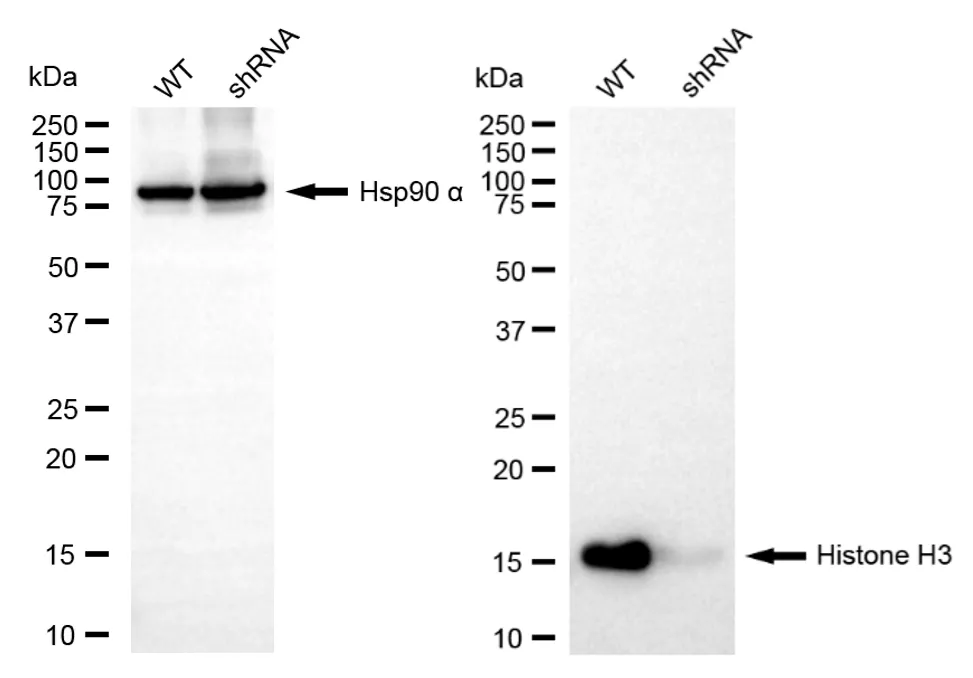
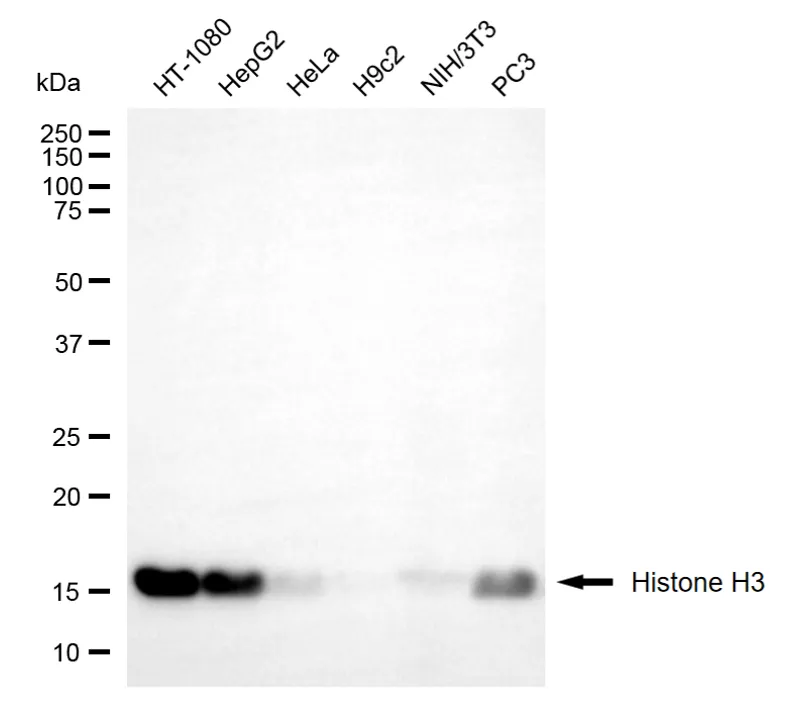
Summary
| Production Name | KD-Validated Histone H3 Mouse Monoclonal Antibody |
| Description | KD-Validated antibody |
| Host | Mouse |
| Application | WB |
| Reactivity | Human,Mouse,Rat |
Performance
| Conjugation | Unconjugated |
| Modification | Unmodified |
| Isotype | Mouse IgG2b |
| Clonality | Mouse mAb |
| Form | Liquid |
| Storage | Store at 4°C short term. Aliquot and store at -20°C long term. Avoid freeze/thaw cycles. |
| Buffer | Supplied in PBS (pH 7.4) containing 50% glycerol, and 0.02% sodium azide. |
| Purification | Affinity purification |
Immunogen
| Gene Name | H3C1 |
| Alternative Names | H3C1; H3 Clustered Histone 1; HIST1H3A; H3/A; H3FA; Histone Cluster 1 H3 Family Member A; H3 Histone Family, Member A; Histone Cluster 1, H3a; Histone 1, H3a; Histone H3.1; Histone H3/A; H3FC HIST1H3C; Histone H3/B; Histone H3/C; Histone H3/D; Histone H3/F; Histone H3/H; Histone H3/I; Histone; H3/J; Histone H3/K; Histone H3/L; HIST1H3B; HIST1H3D; HIST1H3E; HIST1H3F; HIST1H3G; HIST1H3H; HIST1H3I; HIST1H3J; H3C10; H3C11; H3C12; H3C2; H3C3; H3C4; H3C6; H3C7; H3C8; H3FL; H3FB; H3FD; H3FI; H3FH; H3FK; H3FF; H3FJ |
| Gene ID | 8350 |
| SwissProt ID | P68431 |
Application
| Dilution Ratio | WB 1:500-1:2,500 |
| Molecular Weight | Calculated MW: 15.4kDa |
Background
Histones are basic nuclear proteins that are responsible for the nucleosome structure of the chromosomal fiber in eukaryotes. This structure consists of approximately 146 bp of DNA wrapped around a nucleosome, an octamer composed of pairs of each of the four core histones (H2A, H2B, H3, and H4). The chromatin fiber is further compacted through the interaction of a linker histone, H1, with the DNA between the nucleosomes to form higher order chromatin structures. This gene is intronless and encodes a replication-dependent histone that is a member of the histone H3 family. Transcripts from this gene lack polyA tails; instead, they contain a palindromic termination element. This gene is found in the large histone gene cluster on chromosome 6p22-p21.3. [provided by RefSeq, Aug 2015]
Research Area
Epigenetics and Nuclear Signaling