
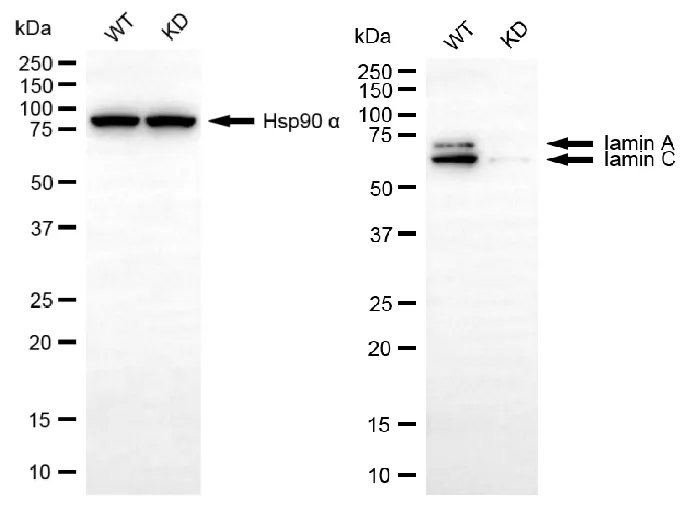
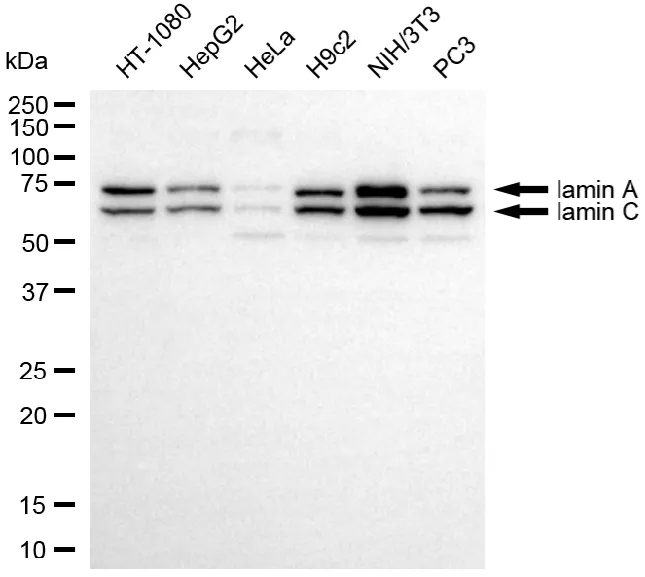
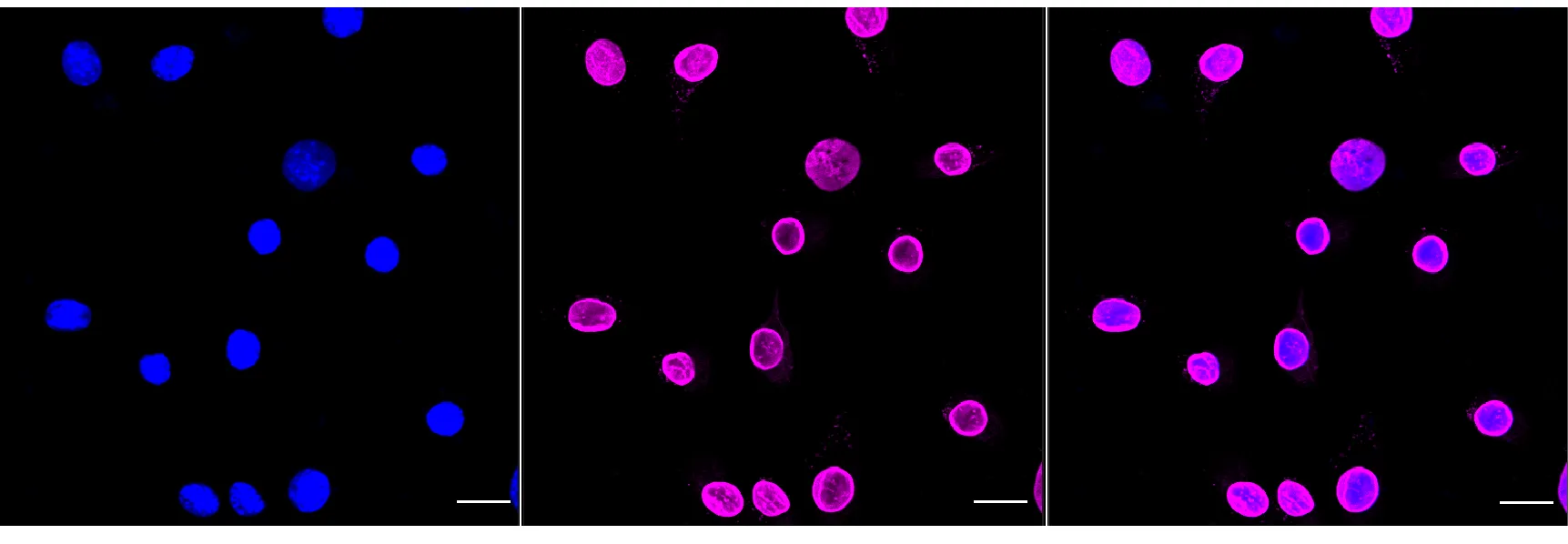
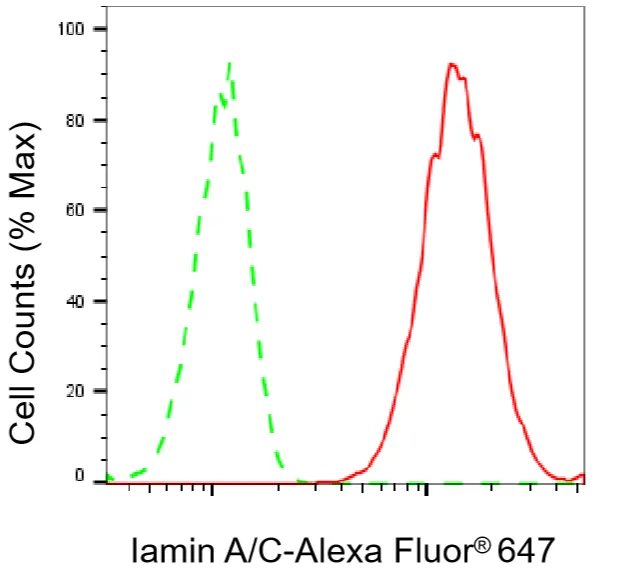
Summary
| Production Name | KD-Validated Lamin A/C Recombinant Rabbit Monoclonal Antibody |
| Description | KD-Validated antibody |
| Host | Rabbit |
| Application | WB,FCM,ICC |
| Reactivity | Human,Mouse,Rat |
Performance
| Conjugation | Unconjugated |
| Modification | Unmodified |
| Isotype | Rabbit IgG |
| Clonality | Rabbit mAb |
| Form | Liquid |
| Storage | Store at 4°C short term. Aliquot and store at -20°C long term. Avoid freeze/thaw cycles. |
| Buffer | Supplied in PBS (pH 7.4) containing 50% glycerol, and 0.02% sodium azide. |
| Purification | Affinity purification |
Immunogen
| Gene Name | LMNA |
| Alternative Names | LMNA; Lamin A/C; HGPS; MADA; LMN1; Mandibuloacral Dysplasia Type A; Lamin A/C-Like 1; Prelamin-A/C; Progerin; LGMD1B; CMD1A; LMNL1; PRO1; Limb Girdle Muscular Dystrophy 1B (Autosomal Dominant); Cardiomyopathy, Dilated 1A (Autosomal Dominant); Epididymis Secretory Sperm Binding Protein; Progeria 1 (Hutchinson-Gilford Type); Renal Carcinoma Antigen NY-REN-32; 70 KDa Lamin; Lamin C; CMT2B1; CDCD1; FPLD2; Lamin; CDDC; EMD2; FPLD; LDP1; LMNC; FPL; IDC; LFP |
| Gene ID | 4000 |
| SwissProt ID | P02545 |
Application
| Dilution Ratio | WB 1:1,000-1:5,000; FC 1:200-1:2,000; ICC 1:100-1:1,000 |
| Molecular Weight | Calculated MW: 74.1kDa |
Background
The protein encoded by this gene is part of the nuclear lamina, a two-dimensional matrix of proteins located next to the inner nuclear membrane. The lamin family of proteins make up the matrix and are highly conserved in evolution. During mitosis, the lamina matrix is reversibly disassembled as the lamin proteins are phosphorylated. Lamin proteins are thought to be involved in nuclear stability, chromatin structure and gene expression. Vertebrate lamins consist of two types, A and B. Alternative splicing results in multiple transcript variants. Mutations in this gene lead to several diseases: Emery-Dreifuss muscular dystrophy, familial partial lipodystrophy, limb girdle muscular dystrophy, dilated cardiomyopathy, Charcot-Marie-Tooth disease, and Hutchinson-Gilford progeria syndrome. [provided by RefSeq, May 2022]
Research Area
Tags & Cell Markers,Signal Transduction