
Size:50μL Price:$218
Size:100μL Price:$318
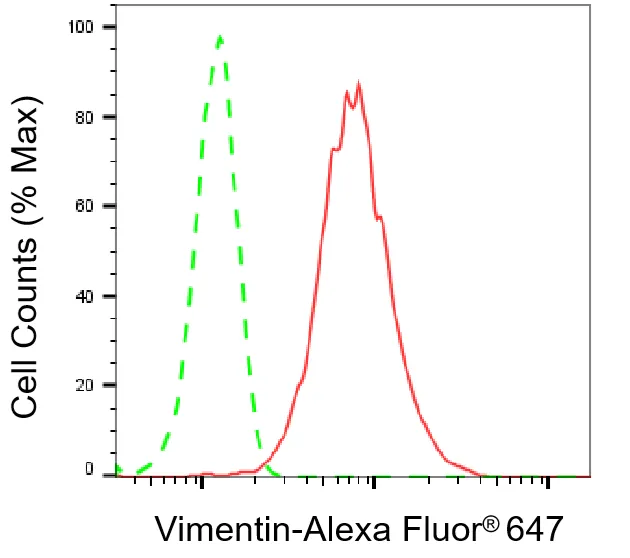
Application:WB,FCM,ICC,IHC-P
Reactivity:Human,Mouse,Rat
Conjugate:Unconjugated
Gene Name:VIM
Summary
Performance
Immunogen
Application
Background
This gene encodes a type III intermediate filament protein. Intermediate filaments, along with microtubules and actin microfilaments, make up the cytoskeleton. The encoded protein is responsible for maintaining cell shape and integrity of the cytoplasm, and stabilizing cytoskeletal interactions. This protein is involved in neuritogenesis and cholesterol transport and functions as an organizer of a number of other critical proteins involved in cell attachment, migration, and signaling. Bacterial and viral pathogens have been shown to attach to this protein on the host cell surface. Mutations in this gene are associated with congenital cataracts in human patients. [provided by RefSeq, Aug 2017]
Research Area
Neuroscience,Signal Transduction,Stem Cells,Cancer,Developmental Biology