
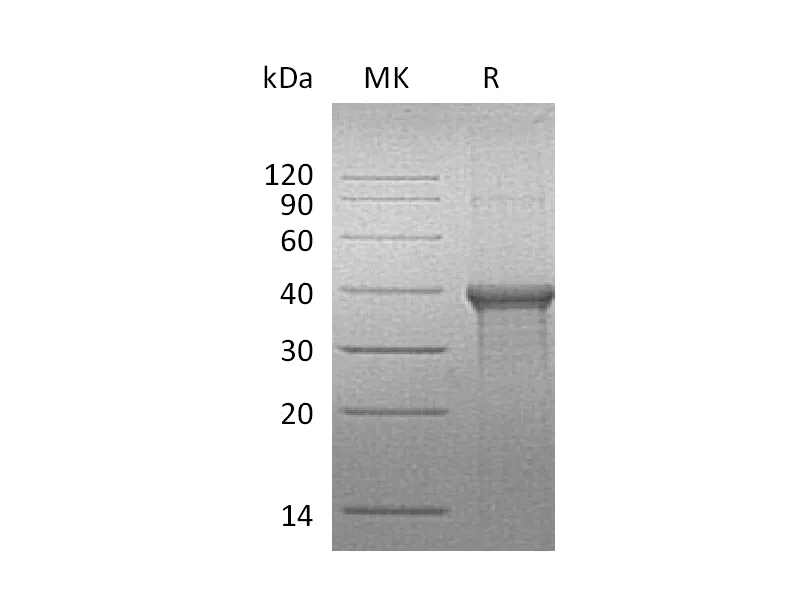
Recombinant Human BLVRA (C-6His)
Size1:10μg price1:$136
Size2:50μg price2:$378
Size3:500μg price3:$1890
Size2:50μg price2:$378
Size3:500μg price3:$1890
SKU:
PEH0154
Detail
Alternative Names
BLVRA;Biliverdin reductase A;BVR A;Biliverdin-IX alpha-reductase;BLVR;BVR
Background
Human Biliverdin reductase A (BLVRA) is belonged to the Gfo/Idh/MocA family and Biliverdin reductase subfamily. BLVRA is an enzyme that in humans is encoded by the BLVRA gene. BLVRA plays an important role in reducing the gamma-methene bridge of the open tetrapyrrole, biliverdin IX alpha, to bilirubin with the concomitant oxidation of a NADH or NADPH cofactor. BLVRA acts on biliverdin by reducing its double-bond between the pyrrole rings into a single-bond. It accomplishes this using NADPH + H+ as an electron donor, forming bilirubin and NADP+ as products.
Note
For Research Use Only , Not for Diagnostic Use.