

Summary
Performance
Immunogen
Application
Background
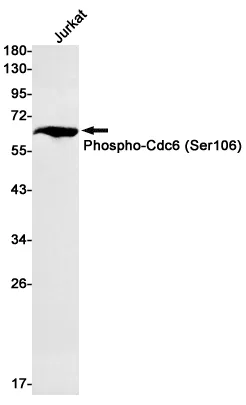
Substrate recognition component of a SCF (SKP1-CUL1-F-box protein) E3 ubiquitin-protein ligase complex which mediates the ubiquitination and subsequent proteasomal degradation of target proteins involved in cell cycle progression, signal transduction and transcription. Substrate recognition component of a SCF (SKP1-CUL1-F-box protein) E3 ubiquitin-protein ligase complex which mediates the ubiquitination and subsequent proteasomal degradation of target proteins involved in cell cycle progression, signal transduction and transcription (PubMed:11931757, PubMed:12435635, PubMed:12769844, PubMed:12840033, PubMed:15342634, PubMed:15668399, PubMed:15949444, PubMed:16103164, PubMed:16262255, PubMed:16581786, PubMed:16951159, PubMed:17908926, PubMed:17962192, PubMed:22770219, PubMed:32267835). Specifically recognizes phosphorylated CDKN1B/p27kip and is involved in regulation of G1/S transition (By similarity). Degradation of CDKN1B/p27kip also requires CKS1. Recognizes target proteins ORC1, CDT1, RBL2, KMT2A/MLL1, CDK9, RAG2, FOXO1, UBP43, YTHDF2, and probably MYC, TOB1 and TAL1 (PubMed:11931757, PubMed:12435635, PubMed:12769844, PubMed:12840033, PubMed:15342634, PubMed:15668399, PubMed:15949444, PubMed:16103164, PubMed:17962192, PubMed:16581786, PubMed:16951159, PubMed:17908926, PubMed:32267835). Degradation of TAL1 also requires STUB1 (PubMed:17962192). Recognizes CDKN1A in association with CCNE1 or CCNE2 and CDK2 (PubMed:16262255). Promotes ubiquitination and destruction of CDH1 in a CK1-dependent manner, thereby regulating cell migration (PubMed:22770219).
Research Area
Cell Biology