
Basic information of human cervical cancer cell HeLa
Source and History:
HeLa, a human cervical cancer cell line, is a non diploid epithelioid cell line isolated from cervical cancer tissue of a 31 year old black female patient in 1951. This cell line exhibits adherent growth characteristics, positive for keratin, low expression of p53, and normal expression of retinoblastoma suppressor factor (pRB).
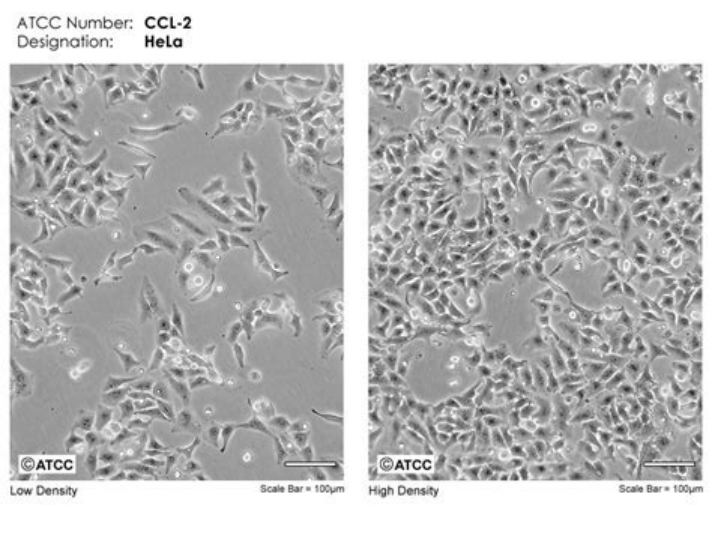
Cell culture conditions:
The culture conditions for HeLa cells typically include the use of MEM medium containing 10% fetal bovine serum (FBS) and 1% bispecific antibody, with a culture environment of 37 ℃, 5% CO ₂, 95% air, and humidity maintained between 70% -80%. In addition, HeLa cells have the ability to rapidly proliferate, with a passage frequency of generally 1:3 or 1:4, and a fluid change every 2-3 days.
The Application of HeLa Cells in Scientific Research
HeLa cells have important application value in scientific research. For example, they are widely used to study the role of human papillomavirus (HPV) in cervical cancer, as well as to explore the molecular mechanisms and therapeutic targets of cervical cancer [1,2].In addition, HeLa cells have also been used for drug screening and cancer treatment research, such as the inhibitory effects of drugs such as cisplatin and ginsenoside R7 on HeLa cells [2,3].
It should be noted that the HeLa cell line, due to its high proliferation ability and potential risk of cross contamination, must strictly comply with the safety regulations of the secondary biosafety laboratory during operation. In addition, since HeLa cells are derived from cervical cancer tissue, they may carry HPV-18 sequences, so it is important to avoid contamination during the experiment.
HeLa cells are an important experimental model widely used in cancer research, drug development, and biological research, but their use must comply with strict laboratory safety regulations.
What are the specific aspects of the importance of HeLa cells in scientific research?
The importance of HeLa cells in scientific research is reflected in multiple aspects, as follows:
1. Cancer research
HeLa cells are an important tool for studying cancer mechanisms. By studying the growth and metastasis characteristics of HeLa cells, scientists can better understand the biological mechanisms of cancer, thereby promoting the development of targeted therapies and treatment plans. In addition, HeLa cells have been used to study the role of specific genes and signaling pathways in cancer development.
2. Vaccine development
HeLa cells have played an important role in vaccine development. For example, they are used in the development of polio vaccines, helping scientists test the effectiveness and safety of the vaccines. In addition, HeLa cells have played a key role in the development of COVID-19 vaccines.
3. Genetic research
HeLa cells have significant importance in the field of genetics. Their complete genomes have been sequenced, providing valuable data for studying human genetic changes. In addition, HeLa cells have been used to study DNA replication and gene expression.
4. Drug testing
HeLa cells, as a model system, are widely used to test the safety and efficacy of new drugs, avoiding experiments on humans or animals. This characteristic makes HeLa cells an important tool for drug development.
5. Virus research
HeLa cells are used to study the pathogenesis of viruses and test antiviral drugs. For example, they are used to study HPV (human papillomavirus), HIV (AIDS virus) and other viruses related to sexual and reproductive health [5].
6. Cell biology research
HeLa cells have made significant contributions in the field of cell biology. Their infinite division ability enables scientists to study basic biological processes such as cell cycle, apoptosis, and signal transduction.
7. Ethics and Informed Consent
The origin of HeLa cells has sparked ethical controversies regarding informed consent and the rights of research subjects. The case of Henrietta Lacus highlights the importance of ethical issues in medical research.
8. Applications in other fields
HeLa cells have also been used to study the effects of radiation and toxic substances, cell behavior in zero gravity environments, gene mapping, and cloning techniques.
HeLa cells have irreplaceable importance in various fields such as cancer research, vaccine development, genetics, drug testing, virus research, and cell biology.
What are the findings of studies on the HeLa cell line carrying the HPV-18 sequence?
The study of HeLa cell lines carrying HPV-18 sequences revealed the following important information:
1. Existence and Characteristics of HPV-18 Sequence
The HeLa cell line does indeed carry the sequence of human papillomavirus (HPV) type 18. These sequences exhibit specific variations and structural features in the genome. For example, a region of the HPV-18 genome (from 128230632 to 128241494) displays multiple mutation points and a large deletion area, while coverage and sequencing depth also vary [7].
2. Genomic structure and variation
The study conducted a detailed analysis of the structure of the HPV-18 genome, including the HapA and HapB regions and their corresponding read counts. In addition, the complete structure of the genome was demonstrated, including regions encoding proteins such as E1 and E2 [7].
3. Detection and analysis of HPV-18 sequences
When using the BMC Bioinformatics dataset for analysis, researchers confirmed the presence of HPV-18 sequences in HeLa cell lines through high-throughput sequencing technology. This study utilized reference sequences from the NCBI database and further validated the integrity of HPV-18 sequences through assembly and alignment analysis [8].
4. The effect of HPV-18 on the biological characteristics of HeLa cells
HeLa cells infected with HPV-18 exhibit various biological characteristic changes. For example, the E6 protein of HPV-18 impairs tumor suppressor function by inhibiting the activity of p53 protein [11]. In addition, HPV-18 infection is also associated with changes in microRNA expression in HeLa cells [9].
5. Integration and Recombination of HPV-18 in HeLa Cells
Research has shown that the HPV-18 genome may have undergone integration and recombination processes in HeLa cells. For example, there are multiple HPV-18 integration sites on the chromosomes of HeLa cells, and these integration sites are closely related to the occurrence of cervical cancer [9]. In addition, chromosome fragmentation and recombination in HeLa cells are also associated with HPV-18 infection [9].
6. The effect of HPV-18 on DNA replication in HeLa cells
Research has found that HeLa cells infected with HPV-18 exhibit phenotype restriction under the action of Cyclin E/CDK2, which may affect the replication efficiency of HPV DNA [10]. However, some experiments have shown that HeLa cells can still support efficient replication of HPV-18 DNA [10].
7. Transmission of HPV-18 in other cell lines
The study also found that HPV-18 not only exists in HeLa cells, but may also spread to other cervical cancer cell lines through cross contamination. For example, HPV-18 sequences were detected in CNE1 and ONEH cell lines, indicating that HPV-18 may have spread through co culture with HeLa cells. [12]
The study on HeLa cell lines carrying HPV-18 sequences revealed the presence, genome structure, biological characteristics, and impact on cell function of HPV-18 in HeLa cells.
References
1. Effect of MiR-375 Regulates YAP1 on the Invasion, Apoptosis, and Epithelial-Mesenchymal Transition of Cervical Cancer HeLa Cells.[ PMID: 34512774]
2. Ji Jing et al. Cisplatin promotes autophagy and apoptosis by increasing Nrf2 nuclear uptake in HeLa-human cervical cancer cells [J]. Journal of Hui Bao Medical University, 2023, 48(3): 301-305.
3. Notoginsenoside R7 suppresses cervical cancer via PI3K/PTEN/Akt/mTOR signaling.[ PMID: 29312623]
4. Recent progress in apoptosis triggering facilitated by HeLa Studies. Maria Teodora Constantin et al. Acta Marisiensis - Seria Medica 2023;69(2):98-103
5. International Scientific Conferences on Medicine & Public Health Research Week 2023
6. Kinetics of empty store-activated Ca2+ influx in HeLa cells.[ PMID: 7509791]
7. The haplotype-resolved genome and epigenome of the aneuploid HeLa cancer cell line.
[PMID: 23925245]
8. Entourage: all-in-one sequence analysis software for genome assembly, virus detection, virus discovery, and intrasample variation profiling.[ PMID: 38914932]
9. New Insights into Cell Culture Technology. Sivakumar Joghi Thatha Gowder.
10. HeLa Cells Are Phenotypically Limiting in Cyclin E/CDK2 for Efficient Human Papillomavirus DNA Replication. [PMID: 38914932]
11. BAG3 down-modulation sensitizes HPV18(+) HeLa cells to PEITC-induced apoptosis and restores p53.[ PMID: 25175321]
12. Comprehensive high-throughput RNA sequencing analysis reveals contamination of multiple nasopharyngeal carcinoma cell lines with HeLa cell genomes. [ PMID: 24991015]