
Interferon Signaling: Type I, II, and III Pathways
A receptor-to-gene guide for designing and interpreting pathway experiments
Interferon signaling at a glance
Interferons (IFNs) are cytokines that regulate antiviral defenses and immune responses. Type I, II and III IFNs use distinct receptors. Type I and III commonly activate a signal transducer and activator of transcription 1 (STAT1)–STAT2–interferon regulatory factor 9 (IRF9) complex, whereas type II IFN classically activates STAT1 homodimers. Cell type and stimulus influence the response.[1]
Receptor binding initiates signaling through receptor-associated Janus kinases (JAKs) at the cell surface; phosphorylated transcription factors accumulate in the nucleus and regulate gene expression. IFN-induced genes include both antiviral effectors and regulators that restrain signaling.
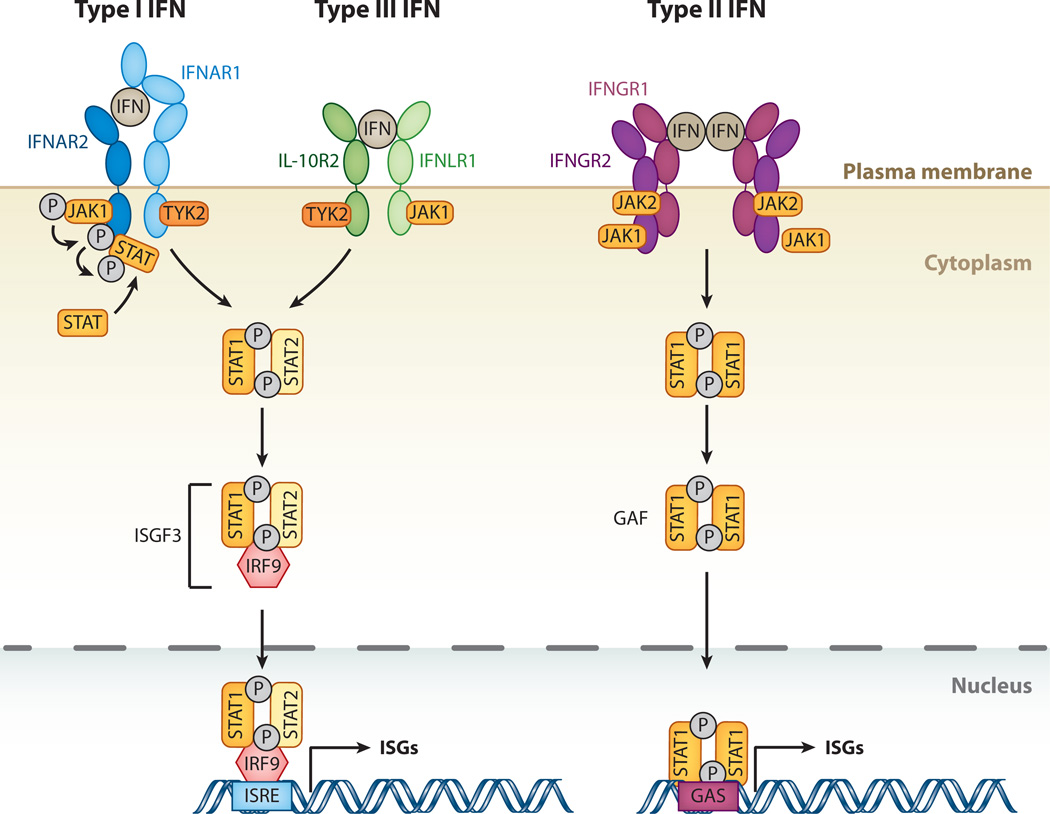
The interferon (IFN)-signaling cascade.
Compare the canonical pathways
| IFN class | Representative ligand and receptor | Associated kinases | Common transcriptional route |
|---|---|---|---|
| Type I | IFN-α / IFN-β → IFNAR1 + IFNAR2 | JAK1 and TYK2 | STAT1 + STAT2 + IRF9 form ISGF3; binds interferon-stimulated response elements (ISREs). |
| Type II | IFN-γ → IFNGR1 + IFNGR2 | JAK1 and JAK2 | STAT1 homodimers form gamma-activated factor (GAF); bind gamma-activated sequence (GAS) elements. |
| Type III | IFN-λ → IFNLR1 + IL10R2 | JAK1 and TYK2 | STAT1 + STAT2 + IRF9 form ISGF3; induces a context-dependent ISRE-linked program. |
Arrows indicate ligand–receptor relationships. The table summarizes common canonical routes, not every signaling complex. IFN-λ receptor expression differs between cell types, so responsiveness must be tested in the chosen system.[1][2]
From receptor engagement to gene expression
For type I and III signaling, activated receptor-associated kinases promote phosphorylation of receptor and STAT proteins. Phosphorylated STAT1 and STAT2 associate with interferon regulatory factor 9 (IRF9) to form interferon-stimulated gene factor 3 (ISGF3). ISGF3 enters the nucleus and promotes transcription at ISRE-containing regulatory elements.[1]
For type II signaling, IFN-γ binds IFNGR1/IFNGR2 and activates JAK1/JAK2. Phosphorylated STAT1 homodimers form GAF and regulate genes through GAS elements. Some genes and alternative STAT routes can overlap between IFN classes; receptor identity and a single gene are therefore insufficient to classify every response.[1]
Regulation and alternative responses
The amplitude and duration of signaling depend on receptor availability, phosphatases, feedback regulators and cell state. Alternative STAT-containing complexes and pathways have been observed in particular contexts, including signaling after changes in unphosphorylated STAT abundance. These mechanisms are context-dependent and should not be presented as universally concurrent with the canonical pathway.[3]
Interferon-stimulated genes can limit different steps of infection, but the effect of a given gene depends on the pathogen and experimental model. Increased transcript abundance alone is not proof of direct antiviral activity.
Choose readouts and controls
| Stage | Example measurement | Key interpretation |
|---|---|---|
| Early signaling | Phospho-STAT1 Tyr701 and total STAT1 by immunoblot | A change in phosphorylation is compatible with pathway activation but is not specific to one IFN class. |
| Complex or localization | STAT nuclear localization or validated complex assay | Protein localization and complex formation answer related, distinct questions. |
| Transcription | ISRE/GAS reporter or a panel of IFN-responsive transcripts | Report timing, reference normalization and untreated control; reporters are context-dependent. |
| Function | Assay appropriate antiviral or immune phenotype | Use matched controls and perturb the proposed receptor or pathway to test dependence. |
Compare untreated and ligand-treated samples at defined time points, measure total protein alongside phospho-protein and use independent biological replicates. Repeated measurements of a single preparation are technical replicates. A receptor-specific perturbation or genetic rescue can help establish pathway dependence; pharmacologic inhibitors require selectivity controls.
Related Products
Select a phospho-specific antibody for the sample species and assay and include a total-protein control. Phospho-STAT1 (Y701) (3W10) Rabbit Monoclonal Antibody (AMRe06018) is listed for western blot of human samples. STAT1 phosphorylation is shared by several signaling inputs and should be interpreted with ligand- and receptor-specific controls.
References
- Schneider WM, Chevillotte MD, Rice CM. Interferon-stimulated genes: a complex web of host defenses. Annu Rev Immunol. 2014;32:513–545. View source
- Kotenko SV, et al. IFN-lambdas mediate antiviral protection through a distinct class II cytokine receptor complex. Nat Immunol. 2003;4:69–77. View source
- Ivashkiv LB, Donlin LT. Regulation of type I interferon responses. Nat Rev Immunol. 2014;14:36–49. View source
 | Voisey Voisey is a technical support specialist at EnkiLife, proficient in immunology and cell biology. She is committed to providing customers with professional and efficient technical support. Additionally, she is involved in research on customers' fields of study and designs highly cost-effective solutions for them. |