
Myc Family Profiling
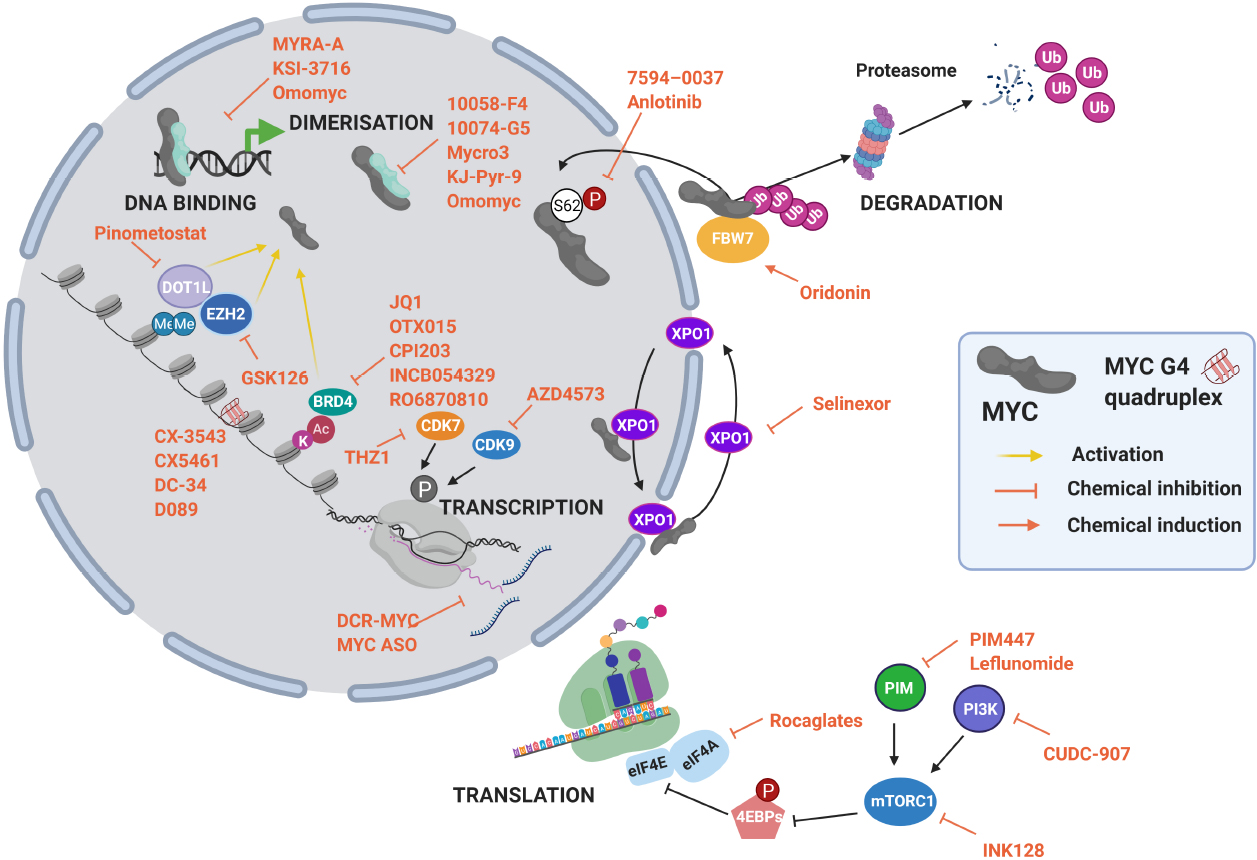
Members of the Myc/Max/Mad network function as transcriptional regulators with roles in various aspects of cell behavior, including proliferation, differentiation, and apoptosis. These proteins share a common basic-helix-loop-helix leucine zipper (bHLH-ZIP) motif required for dimerization and DNA-binding. Max was originally discovered based on its ability to associate with c-Myc and found to be required for the ability of Myc to bind DNA and activate transcription. Subsequently, Max has been viewed as a central component of the transcriptional network, forming homodimers as well as heterodimers with other members of the Myc and Mad families. The association between Max and either Myc or Mad can have opposing effects on transcriptional regulation and cell behavior. The Mad family consists of four related proteins; Mad1, Mad2 (Mxi1), Mad3, and Mad4, and the more distantly related members of the bHLH-ZIP family, Mnt and Mga. Like Myc, the Mad proteins are tightly regulated with short half-lives. In general, Mad family members interfere with Myc-mediated processes, such as proliferation, transformation, and prevention of apoptosis by inhibiting transcription.
The Myc family is comprised of c-Myc, N-Myc, and L-Myc with often distinct patterns of expression during development as well as cancer. Amplification of each of the family members in cancer is frequently mutually exclusive with c-Myc being the most widely studied and most commonly amplified. N-Myc amplification, on the other hand, is found predominantly in neuroblastomas, and L-Myc amplification has been described in small cell lung cancer. Phosphorylation of c-Myc at Thr58 and Ser62 can control proteasomal-dependent degradation of the transcription factor. Phosphorylation of c-Myc at these sites is a stepwise process, whereby mitogens, mitosis, or cellular stress induce phosphorylation at Ser62, which serves as a priming site for GSK-3 phosphorylation of Thr58.
Relevant antibodies
| Catalog# | Product Name | Reactivity | Application |
|---|---|---|---|
| AMRe21557 | c-Myc Rabbit Monoclonal antibody | Human,Mouse,Rat | WB,IHC,IF,IP,ELISA |
| AMM82441 | MYCN Mouse Monoclonal Antibody | Human | IHC,FC,ELISA |
| AMRe05880 | Phospho-c-Myc (T58) (1A2) Rabbit Monoclonal Antibody | Human,Mouse,Rat | WB,ICC/IF,FC |
| AMRe05879 | Phospho-c-Myc (S62) (9Z2) Rabbit Monoclonal Antibody | Human,Mouse,Rat | WB,IHC-P,ICC/IF,FC,IP,IF-P |
| APS0635 | HRP-conjugated Polyclonal Goat Anti-Rabbit IgG(H+L) Secondary Antibody | - | WB, IHC |
| AMre80004 | GAPDH (12R9) Rabbit Monoclonal Antibody | - | WB, control |
Related Products
References
- Blackwood EM, Eisenman RN. Max: a helix-loop-helix zipper protein that forms a sequence-specific DNA-binding complex with Myc. Science. 1991 Mar 8;251(4998):1211-7. [PMID: 2006410].
- Grandori C, Cowley SM, James LP, Eisenman RN. The Myc/Max/Mad network and the transcriptional control of cell behavior. Annu Rev Cell Dev Biol. 2000;16:653-99. [PMID: 11031250].
- Nau MM, Brooks BJ, Battey J, Sausville E, Gazdar AF, Kirsch IR, McBride OW, Bertness V, Hollis GF, Minna JD. L-myc, a new myc-related gene amplified and expressed in human small cell lung cancer. Nature. 1985 Nov 7-13;318(6041):69-73. [PMID: 2997622].
- Benassi B, Fanciulli M, Fiorentino F, Porrello A, Chiorino G, Loda M, Zupi G, Biroccio A. c-Myc phosphorylation is required for cellular response to oxidative stress. Mol Cell. 2006 Feb 17;21(4):509-19. [PMID: 16483932].
- Martínez-Martín S, Soucek L. MYC inhibitors in multiple myeloma. Cancer Drug Resist. 2021 Aug 13;4(4):842-865. [PMID: 35582389].
 | Flora Flora is a technical support expert at EnkiLife, familiar with immunology and neuroscience, dedicated to providing customers with high-quality product combinations and technical support to help achieve research in neurodegenerative diseases and other neuroscience areas. |