
Pfizer has secured FDA approval for Marstacimab (marketed under the brand name Hympavzi), a monoclonal antibody targeting TFPI. This milestone marks remarkable progress in hemophilia management. As the first TFPI-directed antibody authorized by the FDA, Hympavzi delivers a novel therapeutic choice to lower bleeding episodes in adult and adolescent hemophilia A and B patients aged 12 years and older. Its convenient self-administration route also greatly elevates patients’ quality of life. By binding specifically to the Kunitz-2 domain of TFPI, this drug suppresses TFPI activity, modulates the extrinsic coagulation cascade, and restores the physiological equilibrium between bleeding and clot formation. This research breakthrough opens up new perspectives for hemophilia treatment and lays a solid foundation for follow-up mechanism exploration and new drug development. Multiple TFPI-targeted drug candidates are currently under clinical development, which are expected to generate more innovative therapeutic regimens and improve clinical outcomes for hemophilia sufferers.
Tissue Factor Pathway Inhibitor (TFPI) is an intrinsic anticoagulant protein inside the human body, which selectively suppresses the Tissue Factor (TF)-triggered extrinsic coagulation pathway. Structurally, TFPI is a single-chain glycoprotein belonging to the Kunitz-type serine protease inhibitor superfamily, featuring three sequential Kunitz functional domains designated K1, K2 and K3 from the N-terminus to the C-terminus. The K1 domain interacts with the FVIIa-TF complex, whereas the K2 domain binds to activated factor X (FXa). Nevertheless, the exact biological function of the K3 domain remains incompletely elucidated.
In vivo, TFPI exists in three distinct pools:
- The majority of endothelial cell-derived TFPI anchors to the plasma membrane of vascular endothelial cells;
- Platelet-stored TFPI can be released upon thrombin stimulation, participating in localized coagulation regulation;
- Circulating plasma TFPI forms complexes with various lipoproteins.
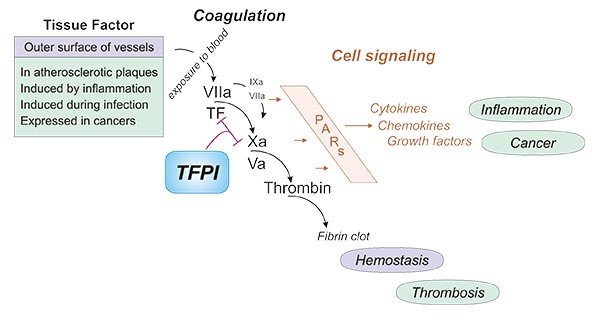
TFPI represents the sole endogenous anticoagulant capable of blocking the extrinsic coagulation cascade initiated by TF. In other words, TFPI exerts robust inhibitory effects on TF-driven coagulation and plays vital roles in leukemia and cardiovascular disease progression. The following sections elaborate on TF itself and the detailed anticoagulation pathways mediated by TFPI.
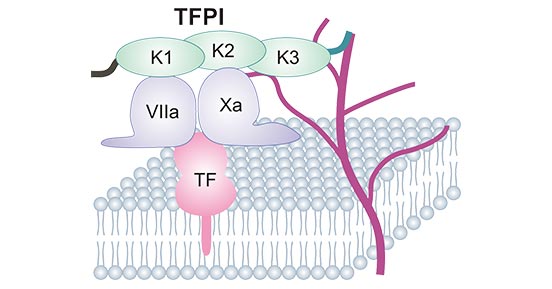
Tissue Factor (TF) is recognized as one of the most potent procoagulant factors in the human organism and acts as the trigger for physiological hemostasis as well as pathological thrombogenesis. The mature TF protein consists of an extracellular segment, a transmembrane region and an intracellular tail. Its extracellular domain serves as the critical binding site for coagulation factor VII (FVII) or activated factor VII (FVIIa), thereby initiating procoagulant reactions.
Under pathological conditions, circulating FVII binds to exposed TF and undergoes rapid activation into FVIIa, assembling the membrane-bound FVIIa-TF complex. With the assistance of phospholipids and calcium ions (Ca²⁺), this bimolecular complex efficiently cleaves zymogen FX into catalytically active FXa. Newly generated FXa further accelerates FVII activation, generating extra FXa and forming a positive feedback loop that amplifies extrinsic coagulation. Meanwhile, TF also activates FIX at a lower reaction rate, leading to massive local thrombin generation and subsequent blood clot formation. Accordingly, TF is capable of initiating both intrinsic and extrinsic coagulation cascades simultaneously.
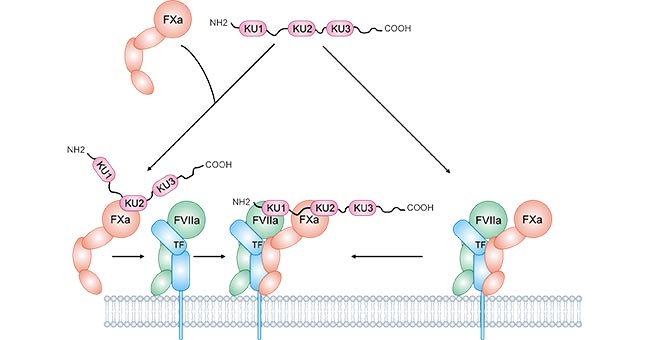
TFPI suppresses TF-initiated coagulation through a negative feedback regulatory loop. Severe endothelial injury triggers TF exposure and activates the extrinsic coagulation pathway; concurrently, inflammatory signals upregulate TFPI expression in vascular endothelial cells to counteract excessive clotting.
Step1: TFPI-K2 binds FXa → conformational change
Step2: FXa-TFPI complex binds FVIIa-TF via TFPI-K1
Step3: Ca²⁺ bridging forms FVIIa-TF-FXa-TFPI tetramer
Step4: Tetramer inactivates FVIIa-TF, blocks extrinsic coagulation
Notably, TFPI only exerts anticoagulant effects after coagulation has been initiated, serving as a brake to restrict excessive TF procoagulant activity. Additionally, TFPI functions as the exclusive inhibitor targeting the FVIIa-TF complex under FXa-deficient circumstances. Collectively, TFPI occupies an irreplaceable regulatory position within the extrinsic coagulation pathway.
Hemophilia is an X-linked hereditary hemorrhagic disorder caused by congenital clotting factor deficiency, which currently lacks curative therapies and requires lifelong treatment intervention. Based on the defective coagulation factor subtype, the disease is classified into hemophilia A (FVIII deficiency) and hemophilia B (FIX deficiency); hemophilia A accounts for approximately 80%–85% of all diagnosed cases and shows higher prevalence clinically.
Coagulation factor replacement remains the standard care for hemophilia patients, but a considerable proportion of patients develop neutralizing antibodies (inhibitors) against infused clotting factors, drastically compromising therapeutic efficacy. Blocking TFPI activity can sufficiently reinforce the TF-initiated extrinsic cascade to complete clot formation independently. Preclinical trials using rabbit hemophilia models verified that neutralizing antibody-mediated TFPI suppression drastically shortened bleeding duration, establishing an innovative therapeutic strategy for hemophilia management.
Healthy vascular endothelial cells do not express surface TF; endothelial damage occurring in angina pectoris, coronary atherosclerosis, cerebral atherosclerosis and other cardiovascular diseases induces TF externalization and endothelial dysfunction. During atherosclerotic lesion progression, TF derived from monocytes and macrophages enters systemic circulation and triggers pathological thrombosis. TFPI counteracts TF activity, alleviates secondary complications and modulates thrombotic progression. Elevated circulating TFPI concentrations have been detected in patients with myocardial infarction, coronary focal ischemia and atherosclerosis, confirming that TFPI restrains thrombus formation and pathological vascular remodeling by antagonizing TF signaling.
Cumulative research confirms that multiple coagulation-related molecules undergo aberrant expression during oncogenesis, and TFPI expression levels vary significantly across different tumor types. Malignant cells and leukemic blast cells secrete cytokines including IL-11 and TNF-α, which stimulate endogenous TFPI biosynthesis. Conversely, TFPI acts as an anti-angiogenic tumor suppressor factor, restricting tumor progression by modulating neovascularization.
Two primary anti-tumor mechanisms:
- TFPI blocks the FVIIa-TF complex, which drives tumor angiogenesis, cell migration, adhesion and proliferation;
TFPI interacts with the very low-density lipoprotein receptor (VLDLR) on tumor cells to directly inhibit cancer cell proliferation and outgrowth.
Data extracted from the Pharmsnap database demonstrates abundant ongoing drug development programs centered on Tissue Factor Pathway Inhibitor (TFPI), dominated by monoclonal antibody candidates. These programs have achieved pivotal breakthroughs in hemophilia treatment and hold expansion potential for sepsis, inflammatory diseases, cardiovascular illnesses and other clinical indications.
Marstacimab, a human IgG1 monoclonal antibody developed by Pfizer, received FDA approval on October 15, 2024, for patients aged 12 years or older living with hemophilia A or B. Concizumab, another TFPI Kunitz-2 domain-targeting monoclonal antibody manufactured by Novo Nordisk, obtained marketing authorization in Japan but failed to pass FDA review owing to elevated thrombotic risk, highlighting the necessity of rigorous safety assessment throughout new drug development pipelines.
KN057 (Armocibart), developed by CStone Pharmaceuticals (Suzhou), represents China’s first domestically developed anti-TFPI monoclonal antibody and has advanced into Phase III clinical trials. This candidate neutralizes TFPI-mediated inhibition of FXa and the TF/FVIIa complex to restore physiological thrombin generation, preventing bleeding episodes in hemophilia A and B patients regardless of inhibitor status.
In summary, these novel agents supply alternative therapeutic choices for hemophilia patients, delivering particular clinical value to individuals who develop clotting factor inhibitors or respond poorly to conventional replacement therapy. With continuous translational research advancement, TFPI-targeted therapeutics are projected to expand to additional disease fields and exhibit expanded market application prospects.
References
Naji D H, et al. Significant genetic association of a functional TFPI variant with circulating fibrinogen levels and coronary artery disease. Molecular genetics and genomics, 2018, 293(1): 119-128.
Lin C C, et al. Atorvastatin or transgenic expression of TFPI inhibits coagulation initiated by anti-nonGal IgG binding to porcine aortic endothelial cells. Journal of Thrombosis and Haemostasis, 2010, 8(9): 2001-2010.
Mackman N, Grover S P, Antoniak S. Tissue factor expression, extracellular vesicles, and thrombosis after infection with the respiratory viruses influenza A virus and coronavirus. Journal of Thrombosis and Haemostasis, 2021, 19(11): 2652-2658.
D'Angelo G. Inflammation and coagulation: a "continuum" between coagulation activation and prothrombotic state. j Blood Disord, 2015, 2(1): 1023.
Adams M. Tissue factor pathway inhibitor: new insights into an old inhibitor. Seminars in thrombosis and hemostasis, 2012, 38(2).
Gomez K, McVey J H. Tissue factor initiated blood coagulation. Front Biosci, 2006, 11(1): 1349-1359.
Alblaihed L, et al. High risk and low prevalence diseases: Hemophilia emergencies. The American Journal of Emergency Medicine, 2022.