
N6-Methyladenosine (m6A) Binding Protein
N6-methyladenosine (m6A) is an abundant RNA modification that plays an important role in mRNA splicing, processing, and stability. The m6A modification is specifically recognized by YT521B homology (YTH) domain-containing proteins, consisting of five members in mammals: YTH domain-containing proteins 1 and 2 (YTHDC1 and YTHDC2), and YTH domain-containing family proteins 1, 2, and 3 (YTHDF1, YTHDF2, and YTHDF3). YTHDC1, also known as splicing factor YT521, regulates alternative splicing by functioning as a key regulator of exon-inclusion or exon-skipping. YTHDC1 promotes exon-inclusion by recruiting pre-mRNA splicing factor SRSF3 to regions containing m6A, while repressing exon-skipping by blocking SRSF10 binding to these same regions. Increased expression of YTHDC1 promotes malignant endometrial carcinoma (EC) through alternative splicing of vascular endothelial growth factor-A (VEGF-A), resulting in an increase in VEGF-165 isoform and increased EC cell invasion. YTHDC2 functions to enhance the translation efficiency of target mRNAs and may play a role in spermatogenesis. All three members of the YTHDF family are paralogs that share similar sequence and domain structure, including the conserved C-terminal YTH domain that specifically interacts with m6A. Despite these similarities, recent studies suggest that YTHDF proteins are involved in distinct regulatory functions with minimal overlap. Specifically, YTHDF1 binding has been reported to promote enhanced mRNA translation, but has no measurable effect on mRNA stability. Conversely, YTHDF2 binding appears to promote mRNA degradation, but has minimal effect on translation efficiency. The function of YTHDF3 is less clear, but it has been proposed to function as an auxiliary protein for both YTHDF1 and YTHDF2, helping to promote either increased mRNA translation or decay, respectively.
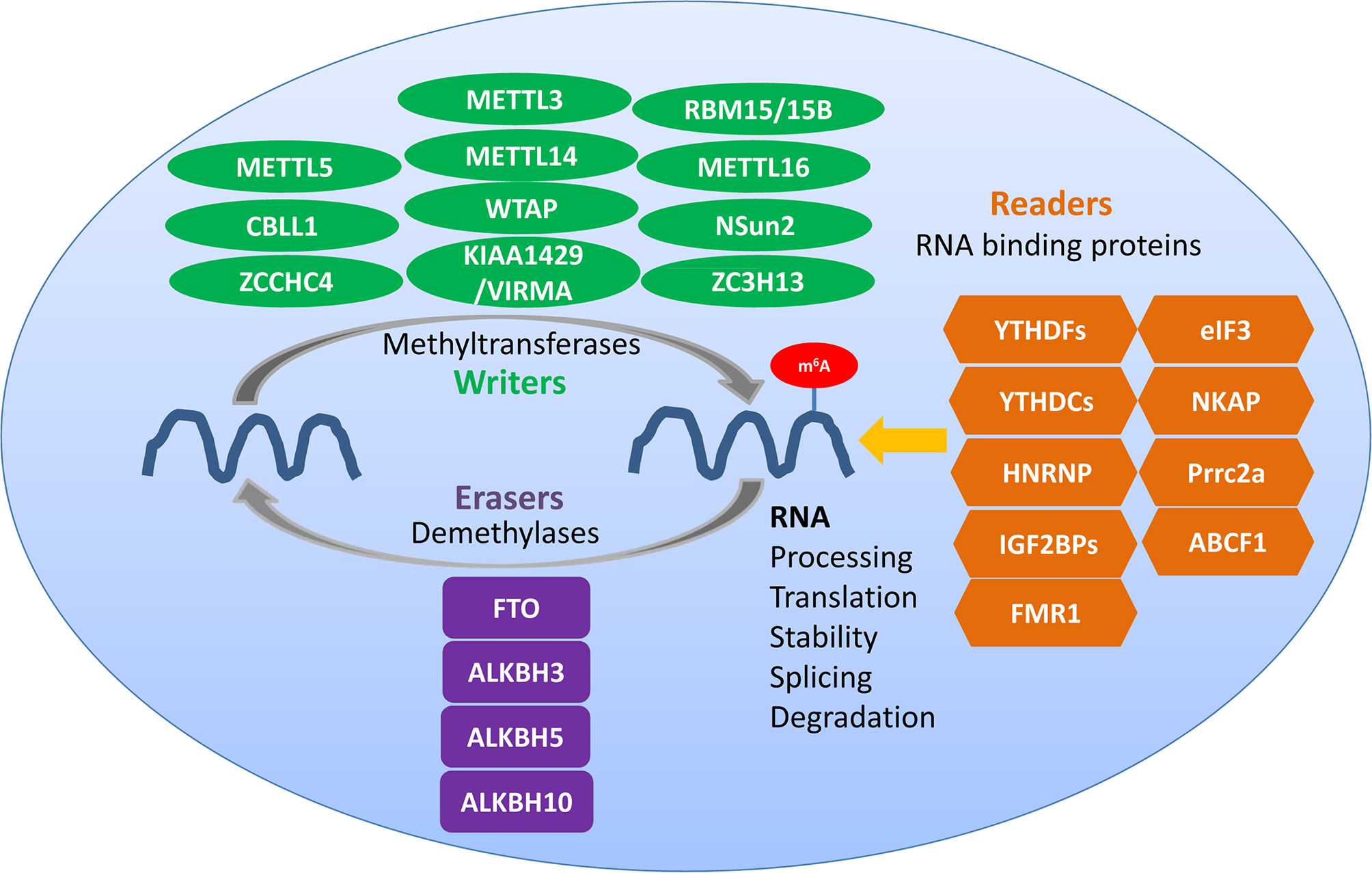
Regulators of m6A methylation within immune cells
Relevent antibodies
| Catalog# | Product Name | Reactivity | Application |
|---|---|---|---|
| AMRe21509 | YTHDF1 Rabbit Monoclonal antibody | Human,Mouse,Rat | WB,IHC,IF,IP,ELISA |
| AMRe21415 | YTHDF2 Rabbit Monoclonal antibody | Human,Mouse,Rat | WB,IHC,IF,IP,ELISA |
| AMRe86598 | YTHDF3 (DGR15903) Rabbit mAb | Human, Mouse, Rat | WB,IHC,FC,IP |
| AMRe87623 | YTHDC1 (DGR15718) Rabbit mAb | Human,Mouse,Rat | WB, IHC-P |
| APS0635 | HRP-conjugated Polyclonal Goat Anti-Rabbit IgG(H+L) Secondary Antibody | ||
| AMre80004 | GAPDH (12R9) Rabbit Monoclonal Antibody |
Related Products
References
- Zhang B, Shao X, Zhou J, Qiu J, Wu Y, Cheng J. YT521 promotes metastases of endometrial cancer by differential splicing of vascular endothelial growth factor A. Tumour Biol. 2016 Dec;37:15543-15549.[PMID: 26289848].
- Xu C, Liu K, Ahmed H, Loppnau P, Schapira M, Min J. Structural Basis for the Discriminative Recognition of N6-Methyladenosine RNA by the Human YT521-B Homology Domain Family of Proteins. J Biol Chem. 2015 Oct 9;290(41):24902-13.[PMCID: PMC4598999].
- Guo L, Yang H, Zhou C, Shi Y, Huang L, Zhang J. N6-Methyladenosine RNA Modification in the Tumor Immune Microenvironment: Novel Implications for Immunotherapy. Front Immunol. 2021 Dec 9;12:773570. [PMID: 34956201].
 | Flora Flora is a technical support expert at EnkiLife, familiar with immunology and neuroscience, dedicated to providing customers with high-quality product combinations and technical support to help achieve research in neurodegenerative diseases and other neuroscience areas. |