
Vesicle Trafficking Antibody
Vesicle trafficking is an integral cellular process and the associated proteins involved also play major roles in other signaling pathways. Caveolins are involved in diverse biological functions including vesicular trafficking, cholesterol homeostasis, cell adhesion, apoptosis, and are also indicated in neurodegenerative disease (1). It is believed that caveolins serve as scaffolding proteins for the integration of signal transduction. Phosphorylation at Tyr14 is essential for caveolin association with SH2 or PTB domain-containing adaptor proteins, such as GRB7 (2-4).
Clathrin-coated vesicles provide for the intracellular transport of proteins following endocytosis and during multiple vesicle trafficking pathways. Vesicles form at specialized areas of the cell membrane where clathrin and associated proteins form clathrin-coated pits. Invagination of these cell membrane-associated pits internalizes proteins and forms an intracellular clathrin-coated vesicle (5,6). Clathrin is the most abundant protein in these vesicles and is present as a basic assembly unit called a triskelion. Each clathrin triskelion is composed of three clathrin heavy chains and three clathrin light chains. Clathrin heavy chain proteins are composed of several functional domains that associate with other vesicle proteins (6).
The APPL1 multidomain adaptor protein is a BAR-domain protein family member that is involved in membrane trafficking within a number of signal transduction pathways (7).
EEA1 is an early endosomal marker and a Rab5 effector protein essential for early endosomal membrane fusion and trafficking (8,9). Syntaxin 6 is a ubiquitously expressed S25C family member of the SNARE proteins (10,11). Syntaxin 6 protein is localized to the trans-Golgi and within endosomes and regulates membrane trafficking by partnering with a variety of other SNARE proteins (12-14). It has two coiled-coil domains (CC1 and CC2) located in the amino-terminal region and a PDZ domain in the carboxy-terminal region (15). The CC2 domain and its adjacent linker region mediate the association of GOPC with the Golgi protein golgin-160 and the Q-SNARE protein syntaxin 6 (15,16). The PDZ domain of GOPC interacts with the carboxy terminus of target proteins to mediate target protein vesicular trafficking and surface expression (17-20).
Rab5 is a member of the Ras superfamily of small Rab GTPases. Rab5 is localized at the plasma membrane and early endosomes and functions as a key regulator of vesicular trafficking during early endocytosis (21).
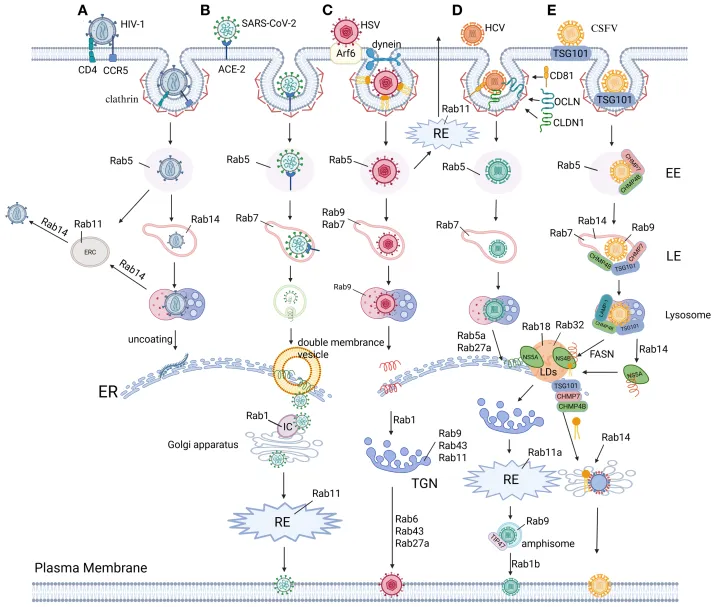
The role of Rab proteins in virus replication.
Relevant Antibodies
| Catalog# | Product Name | Application | Reactivity |
|---|---|---|---|
| APRab04389 | Caveolin-1 (phospho Tyr14) Rabbit Polyclonal Antibody | WB,ELISA | Human,Mouse,Rat |
| AMRe21284 | Caveolin-1 Rabbit Monoclonal antibody | WB,IHC,IF,IP,ELISA | Human,Mouse,Rat |
| AMRe21547 | Clathrin Heavy Chain Rabbit Monoclonal antibody | WB,IHC,IF,ELISA | Human,Mouse,Rat |
| AMRe01666 | APPL Rabbit Monoclonal Antibody | WB,IHC-P | Human,Mouse,Rat |
| AMRe21570 | EEA1 Rabbit Monoclonal antibody | WB,IHC,IF,IP,ELISA | Human,Mouse,Rat |
| AMRe21505 | Rab 5A Rabbit Monoclonal antibody | WB,IHC,IF,IP,ELISA | Human,Mouse,Rat |
| AMRe84321 | PIST Rabbit Monoclonal | WB,IP,IHC,ICC,FC,IF | Human,Mouse |
| APS0635 | HRP-conjugated Polyclonal Goat Anti-Rabbit IgG(H+L) Secondary Antibody | ELISA,WB,Dotblot | Mouse |
| AMRe80004 | GAPDH (12R9) Rabbit Monoclonal Antibody | WB,ELISA | Human,Mouse,Rat,Rabbit,Dog,Monkey |
Related Products
· Super-sensitive ECL chemiluminescent reagent
· IHC Kit
References
- Smart, E.J. et al. (1999) Mol Cell Biol 19, 7289-304.
- Nomura, R. and Fujimoto, T. (1999) Mol Biol Cell 10, 975-86.
- Volonté, D. et al. (2001) J Biol Chem 276, 8094-103.
- Lee, H. et al. (2000) Mol Endocrinol 14, 1750-75.
- Rodriguez-Boulan, E. et al. (2005) Nat Rev Mol Cell Biol 6, 233-47.
- Mousavi, S.A. et al. (2004) Biochem J 377, 1-16.
- Habermann, B. (2004) EMBO Rep 5, 250-5.
- Mu, F.T. et al. (1995) J Biol Chem 270, 13503-11.
- Christoforidis, S. et al. (1999) Nature 397, 621-5.
- Bock, J.B. et al. (2001) Nature 409, 839-41.
- Bock, J.B. et al. (1996) J Biol Chem 271, 17961-5.
- Wendler, F. and Tooze, S. (2001) Traffic 2, 606-11.
- Bock, J.B. et al. (1997) Mol Biol Cell 8, 1261-71.
- Mallard, F. et al. (2002) J Cell Biol 156, 653-64.
- Charest, A. et al. (2001) J Biol Chem 276, 29456-65.
- Hicks, S.W. and Machamer, C.E. (2005) J Biol Chem 280, 28944-51.
- Cheng, J. et al. (2002) J Biol Chem 277, 3520-9.
- He, J. et al. (2004) J Biol Chem 279, 50190-6.
- Wente, W. et al. (2005) J Biol Chem 280, 32419-25.
- Ito, H. et al. (2006) Biochem J 397, 389-98.
- Zerial, M. and McBride, H. (2001) Nat Rev Mol Cell Biol 2, 107-17.
 | Voisey Voisey is a technical support specialist at EnkiLife, proficient in immunology and cell biology. She is committed to providing customers with professional and efficient technical support. Additionally, she is involved in research on customers' fields of study and designs highly cost-effective solutions for them. |