
The types of ELISA
ELISA can be used to determine antigens and also for antibodies. There are three necessary reagents in this assay: (1) Antigens or antibodies adsorbed by solid-phase carriers. (2) Enzyme-labeled antigens or antibodies. (3) Substrates for enzymatic reactions. Depending on the source of the reagent and the specimen and the specific conditions of the test, various types of testing methods can be designed.
There are different opinions on the detection and classification of ELISA, and different literatures have different classification opinions in terms of principle or operation. Here we divide ELISA into the following four categories, and then explain each category in detail: (1) direct ELISA; (2) indirect ELISA; (3) Sandwich ELISA; (4) Competition inhibits ELISA. All other ELISA methods belong to these four types of ELISA or are derived from combinations of these four types of ELISA.
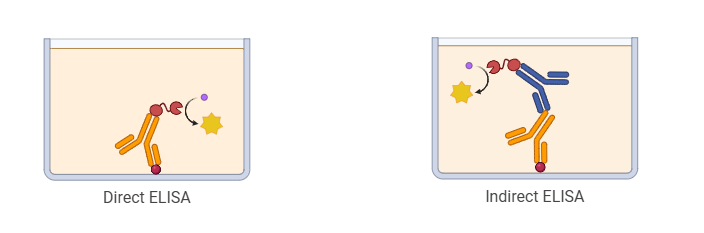
1. Direct ELISA
Direct ELISA is the simplest type of ELISA in terms of procedure. Its method involves directly coating an antigen or antibody onto a solid-phase carrier, followed by specific binding with an enzyme-labeled antibody or antigen, and then using the enzyme to catalyze the color development of the substrate. The depth of the color developed is proportional to the amount of the added enzyme-labeled antibody or antigen. Although direct ELISA is very simple to operate and has relatively concise steps, its application range is still quite limited. One important reason is that only one step of signal amplification is involved in this type of ELISA, so its sensitivity is not very high. In addition, the substances it can detect are also very limited, as it can only measure enzyme-labeled molecules.
2. Indirect ELISA
Indirect ELISA is commonly used for antibody detection. Its initial procedural steps are largely consistent with those of direct ELISA, with the key difference being that in indirect ELISA, the molecule that binds to the pre-coated antigen is an unlabeled antibody rather than an enzyme-labeled one. Subsequently, a second antibody is added; this secondary antibody is enzyme-labeled and can specifically bind to the primary antibody. Finally, a substrate is introduced to induce color development, and the results are interpreted. When the concentration of the secondary antibody is fixed, the final intensity of color development is positively correlated with the amount of the primary antibody.
Since secondary antibodies are generally polyclonal antibodies, multiple secondary antibody molecules can bind to a single primary antibody molecule. Meanwhile, multiple enzyme molecules can be conjugated to one secondary antibody molecule, which significantly enhances the detection sensitivity. Additionally, secondary antibodies are relatively easy to prepare and have been commercially available for a long time. This eliminates the need for operators to label primary antibodies with enzymes, greatly reducing the workload.
Indirect ELISA plays a crucial role in determining antibody titer, serum titer, and screening monoclonal antibodies. In clinical diagnostics, it also serves as an important method for detecting marker antibodies.
3. Sandwich ELISA
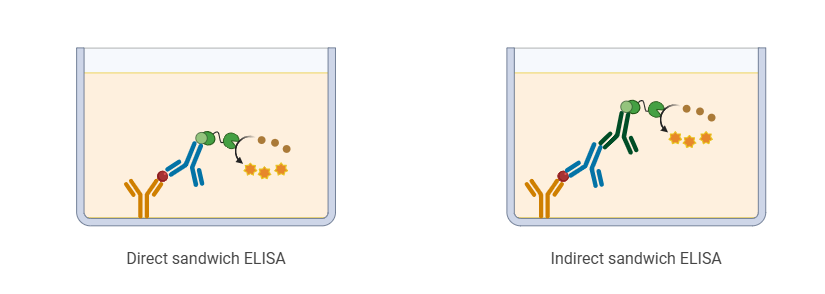
In general, sandwich ELISA can be divided into two types: direct sandwich ELISA and indirect sandwich ELISA.
Direct sandwich ELISA can be further divided into two subtypes: double-antibody sandwich ELISA and double-antigen sandwich ELISA.
Double-antibody sandwich ELISA The first antibody (capture antibody) is coated onto a solid-phase carrier. Then, the antigen to be detected is added. After incubation, the second antibody (detection antibody) is introduced. The capture antibody and detection antibody can be either two monoclonal antibodies targeting different epitopes, or one monoclonal antibody and one polyclonal antibody targeting the same antigen. However, the detection antibody must be enzyme-labeled. For double-antibody sandwich ELISA, the target analyte (antigen to be detected) must contain two or more epitopes; otherwise, the detection antibody cannot bind to the antigen. For example, haptens and small-molecule antigens cannot be detected using double-antibody sandwich ELISA.
Double-antigen sandwich ELISA The operation is basically the same as that of the double-antibody sandwich assay. The difference is that the coated substance is an antigen, the object to be detected is an antibody, followed by the addition of an enzyme-labeled antigen, and then a substrate to induce color development. The basic operational procedure of the double-antigen sandwich ELISA is roughly consistent with that of the indirect ELISA, but the core difference lies in that it uses a specific antigen instead of the enzyme-labeled secondary antibody used in the indirect ELISA. This design achieves screening through the specific binding of dual antigens to the target antibody, effectively reducing interfering factors such as non-specific antibodies and cross-reactions, so its detection specificity is better than that of the indirect ELISA. However, this method also has obvious technical cost limitations: it requires the simultaneous preparation of two key reagents, the coated antigen and the enzyme-labeled antigen, and there are strict requirements for the purity and activity stability of these two antigens, resulting in the overall R&D and production costs being significantly higher than those of the indirect ELISA.
Indirect sandwich ELISA Its principle is as follows: a species-specific antibody is coated onto a solid-phase carrier to serve as the capture antibody. After a blocking step, the antigen to be detected is added and incubated. Following washing, another species-specific antibody is added to act as the detection antibody. Finally, an enzyme-labeled secondary antibody is introduced, and a substrate is then added to induce color development.
Compared with the direct double-antibody sandwich ELISA, the indirect sandwich ELISA incorporates an enzyme-labeled secondary antibody that specifically recognizes the detection antibody. This is equivalent to adding an additional signal amplification step to the entire system, making the final results more sensitive than those of the direct double-antibody sandwich ELISA. Meanwhile, since the enzyme-labeled secondary antibody in the indirect sandwich ELISA can only recognize the detection antibody and not the capture antibody, the specificity of the system is also guaranteed. Therefore, most of our company's ELISA kits adopt this method, totaling over two thousand. If you have any needs, please contact us. Visit our website to view ELISA kit.
4. Competitive Inhibition ELISA
Competitive Inhibition ELISA, also known as Blocking ELISA, its main principle is to use the antigen or antibody to be detected to interfere with a pre-designed system. The final color development result is negatively correlated with the degree of interference caused by the antigen or antibody to be detected. Competitive Inhibition ELISA has high flexibility, and more complex experimental protocols can be designed based on it, thus deriving a variety of special ELISA methods such as Direct Competitive Inhibition ELISA, Indirect Competitive Inhibition ELISA, and Sandwich Competitive ELISA. Here, only Direct Competitive Inhibition ELISA and Indirect Competitive Inhibition ELISA are taken as examples to briefly explain the principle.
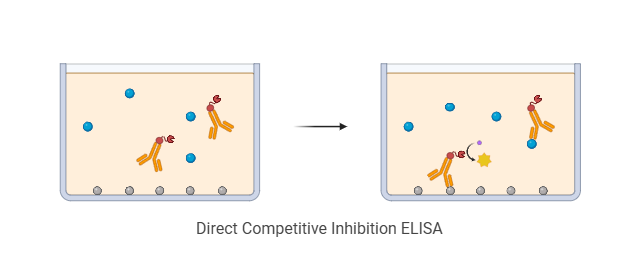
Direct Competitive Inhibition ELISA The antigen is pre-coated on a solid-phase carrier, and enzyme-labeled specific antibodies are added. During the experiment, the antigen or antibody to be detected is introduced. If the target to be detected is an antigen, it will compete with the pre-coated antigen on the solid-phase carrier for the added enzyme-labeled antibodies. If the target to be detected is an antibody, it will compete with the added enzyme-labeled antibodies to bind to the antigen coated on the solid-phase carrier. In both cases, the enzyme-labeled antibodies that are outcompeted are washed away during the washing step, after which a substrate is added to induce color development. The color development result is inversely proportional to the amount of the antigen or antibody to be detected. Direct competitive inhibition ELISA involves two steps of signal amplification, so it has relatively high sensitivity. After pre-coating the solid-phase carrier and adding the enzyme-labeled antibodies, the experiment only requires diluting the antigen or antibody to be detected and adding it to the system for reaction, which greatly simplifies the ELISA operation process.
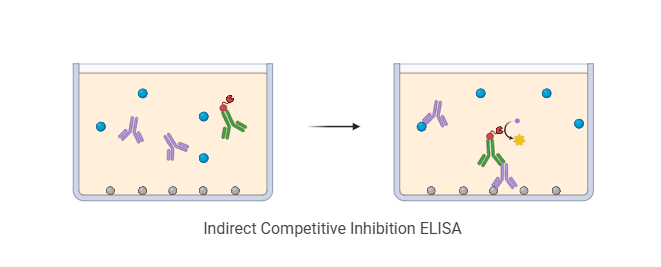
Indirect Competitive Inhibition ELISA The antigen is pre-coated on a solid-phase carrier, and a specific antibody and the corresponding enzyme-labeled secondary antibody against this antibody are added sequentially to form a preliminary system. During the experiment, the diluted antigen to be detected is added, and the antigen in the sample to be tested will compete with the antigen bound to the solid-phase carrier in the preliminary system for binding to the specific antibody. Similarly, the sample to be tested can also be an antibody. Indirect competitive inhibition ELISA has higher detection sensitivity, which benefits from the signal amplification effect mediated by the enzyme-labeled secondary antibody. This method does not require labeling the primary antibody; instead, it can use commercial enzyme-labeled secondary antibodies to adapt to various different primary antibodies, resulting in stronger versatility. At the same time, it effectively reduces the cost and technical difficulty of the antigen labeling process. This method is used in the newly launched product food safety testing kit. If you have any needs, you can contact us. Visit our website to view ELISA kit.
In addition to the several basic ELISA types introduced above, other types of ELISA can also be flexibly designed according to actual needs. For example, biotin-avidin can be introduced to increase the amplification factor of the system; another example is that unlabeled secondary antibodies, Protein A, Protein G, etc., can be introduced to increase the loading capacity of the solid-phase carrier or enhance the specificity of the system.
 | Felicia Felicia is a technical support specialist at EnkiLife, with extensive professional experience in antibody development, optimization, and ELISA assay design and application. She is committed to assisting our clients in selecting suitable antibody products, optimizing ELISA experimental protocols, and resolving technical challenges encountered in the process, thereby supporting the smooth progress of their life science research projects. |