
Recombinant Antibody Development——From Design to Expression
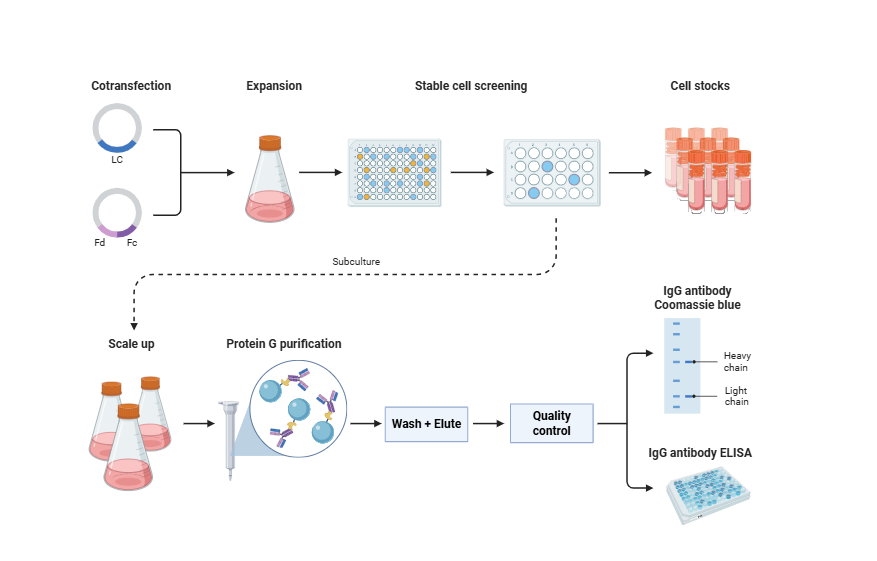
Recombinant antibodies, also known as genetically engineered antibodies, refer to antibodies obtained through the following process: first, the corresponding gene sequences of antibodies are modified and recombined as needed using DNA recombination technology, then constructed into plasmids, and finally the constructed plasmids are transfected/transformed into suitable host cells for expression via protein heterologous expression technology.
The development of recombinant antibodies involves multiple sub-modules, including antibody screening, sequence optimization, antibody engineering modification, expression vector construction, and functional verification. Through a systematic service process, it can support various scenarios such as basic scientific research, biological product development, and preclinical validation, significantly improving the efficiency and quality of antibody acquisition.
1. Antibody Screening Platforms and Strategies
Based on project requirements and sample sources, antibody screening typically employs the following three technical platforms:
Phage display technology: Suitable for constructing large-scale scFv or Fab antibody libraries, and widely used in affinity maturation of target antibodies and epitope screening.
Hybridoma technology: Applicable to the development of immune antibodies in animals such as mice, with a mature platform for screening and subcloning.
Single B cell screening technology: Through flow cytometric sorting and single-cell sequencing technology, it can directly obtain human or animal-derived antibodies with natural heavy chain-light chain pairings.
2. Antibody Sequence Design and Engineering Optimization
The core of recombinant antibody development lies in the engineering design of antibody sequences, which mainly includes the following aspects:
Antibody humanization: For antibodies derived from non-human species such as mice, the immunogenicity can be reduced by retaining the CDR sequences and replacing the framework sequences.
Affinity enhancement: Through structural modeling or site-directed mutagenesis, a mutant library is constructed followed by a second round of screening to obtain antibody variants with higher affinity.
Structural configuration selection: According to application requirements, design full-length IgG antibodies, scFv, Fab, VHH single-domain antibodies, or further construct bispecific antibody structures.
Meanwhile, sequence optimization should also take into account various parameters such as aggregation tendency, thermal stability, and retention of glycosylation sites to meet the needs of subsequent expression and functional verification.
3. Expression System Construction and Antibody Production
Common mammalian expression systems include CHO cell and HEK293 cell systems.
CHO cell expression system is currently the most widely used antibody expression platform. It is suitable for long-term stable expression, high-level secretion, and industrial scale-up production, and supports the transition to GLP or GMP standards.
HEK293 expression system is suitable for small-scale expression, rapid screening, or transient transfection experiments, and is applicable to antibody expression verification in the early and middle stages.
For the design of expression vectors, factors such as promoters (e.g., CMV, EF1α), enhancer elements (e.g., WPRE), signal peptide sequences, and terminator selection should be considered, and codon optimization should be performed. The constructed expression vectors achieve recombinant antibody expression through transfection, stable clone screening, or transient expression.
4. Purification and Functional Verification
After the production of recombinant antibodies, a standardized purification and quality assessment process is required.
For antibody purification, Protein A/G affinity chromatography is used for the initial purification of antibodies. If necessary, SEC is supplemented to remove aggregates. Quality testing includes SDS-PAGE, SEC-HPLC, endotoxin detection, and antibody concentration determination. Functional verification involves tests such as ELISA, WB, IHC, SPR or BLI affinity detection. For some projects, additional cell neutralization assays or Fc-mediated functional analyses (e.g., ADCC) are also required.
FAQs
Q1: What is the difference between recombinant antibodies and traditional antibodies?
A1: Since recombinant antibodies are produced from a specific set of genes, their production is controllable. Theoretically, recombinant antibodies targeting any antigen can be constructed. Meanwhile, issues such as gene deletion, gene mutation, and cell line drift caused by hybridomas can be avoided. Therefore, batch-to-batch variation is very small, and the results are highly reproducible. Using recombinant technology, the specificity and sensitivity of antibodies can be more easily improved through antibody engineering. During the hybridoma and recombinant cloning stages, we can select the desired clones to screen out the highest-quality antibodies.
Q2: Why are CHO cells used for expressing most recombinant antibodies?
A2: The CHO cell expression system possesses excellent protein folding and humanized glycosylation capabilities, along with high expression levels, making it suitable for long-term stable production. Moreover, its safety and feasibility have been validated by a number of approved antibody drugs already on the market.
Q3: Will antibody humanization definitely affect activity?
A3: Improper humanization design may affect binding ability, but through structural modeling and multiple rounds of affinity optimization, the original function can be retained or even enhanced, while reducing immunogenicity.
Q4: What are the common causes of antibody expression failure?
A4: Common causes include incorrect construction of the expression vector, mismatched codon preference, defective signal peptide function, cytotoxic expressed proteins, and abnormal structural regions in the antibody's own sequence.
Q5: What are the differences between the expression and purification of recombinant antibodies and those of recombinant proteins?
A5: The underlying logic of the two processes is the same: both involve constructing an expression vector through gene cloning, achieving heterologous expression in host cells, and then isolating and purifying the target protein based on its physical, chemical, or biological properties. However, there are significant differences in key steps. Essentially, recombinant antibodies are a specific subclass of recombinant proteins.
In terms of expression system selection, recombinant antibodies prioritize eukaryotic systems such as CHO and HEK293 cells, which require glycosylation modification to ensure their activity. In contrast, common recombinant proteins can be flexibly expressed in prokaryotic, eukaryotic, or other systems, with no mandatory requirement for glycosylation.
For purification, recombinant antibodies first undergo Protein A/G/L chromatography, which leverages the specific binding of the antibody’s constant region to rapidly increase purity to over 90%. Subsequent fine purification is then performed using methods like ion exchange chromatography or hydrophobic interaction chromatography. For common recombinant proteins, purification methods—such as affinity chromatography (e.g., His-tag, GST-tag), ion exchange chromatography, and gel filtration chromatography—are selected based on the protein’s specific properties.
Recombinant rabbit monoclonal antibodies launched by EnkiLife provide efficient solutions for scientific research needs, leveraging an extensive portfolio of over 7,000 varieties and full compatibility with diverse experimental scenarios.
Compared with traditional monoclonal antibodies, our recombinant rabbit mAbs are precisely constructed via genetic engineering technology. This not only completely avoids potential batch-to-batch variations associated with hybridoma technology but also achieves higher specificity and affinity, effectively reducing experimental interference caused by non-specific binding. Meanwhile, their stable production process ensures consistent batch-to-batch performance, making experimental results more reliable.
Currently, our recombinant rabbit mAbs fully cover mainstream experimental scenarios such as WB, ICC/IF, IP, IHC. Whether for protein qualitative and quantitative analysis, tissue section staining, or protein-protein interaction research, they can accurately meet the needs, helping researchers advance experimental processes efficiently. Visit our website to view Recombinant Rabbit Monoclonal Antibody.
 | Felicia Felicia is a technical support specialist at EnkiLife, with extensive professional experience in antibody development, optimization, and ELISA assay design and application. She is committed to assisting our clients in selecting suitable antibody products, optimizing ELISA experimental protocols, and resolving technical challenges encountered in the process, thereby supporting the smooth progress of their life science research projects. |