
Gluconeogenesis
Enolase is an important glycolytic enzyme involved in the interconversion of 2-phosphoglycerate to phosphoenolpyruvate. Mammalian enolase exists as three subunits: enolase-1 (α-enolase), enolase-2 (γ-enolase), and enolase-3 (β-enolase). Expression of the enolase isoforms differs in a tissue specific manner. Enolase-1 plays a key role in anaerobic metabolism under hypoxic conditions and may act as a cell surface plasminogen receptor during tissue invasion. Abnormal expression of enolase-1 is associated with tumor progression in some cases of breast and lung cancer. Alternatively, an enolase-1 splice variant (MBP-1) binds the c-myc promoter p2 and may function as a tumor suppressor. For this reason, enolase-1 is considered as a potential therapeutic target in the treatment of some forms of cancer. Research studies have shown elevated levels of neuron-specific enolase-2 in neuroblastoma and small-cell lung cancer.
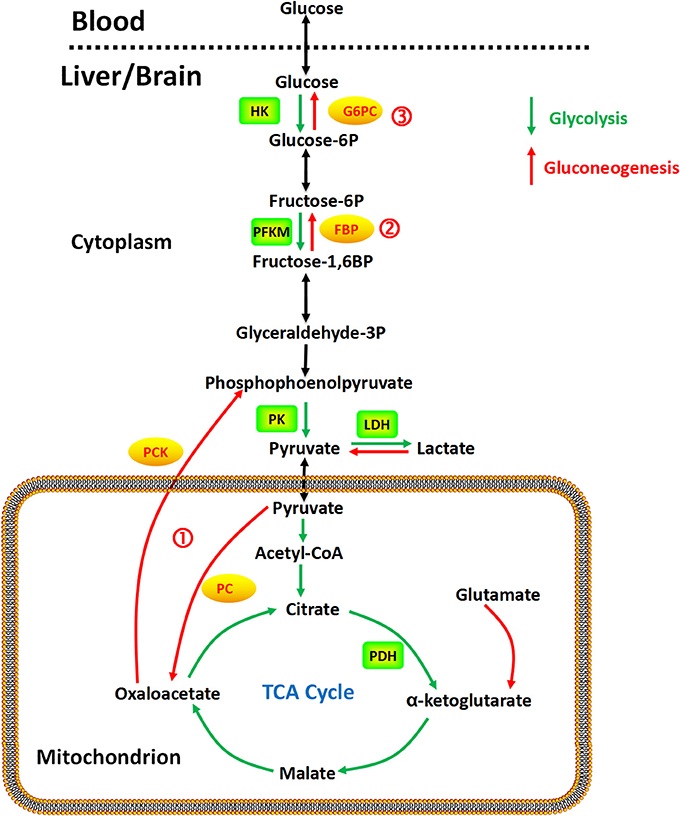
Fructose-1,6-bisphosphatase 1 (FBP1 or FBPase 1), a rate-limiting enzyme in gluconeogenesis, catalyzes the conversion of fructose-1,6-bisphosphate to fructose-6-phosphate. Inhibition of (FBP1) expression in basal-like breast cancer (BLBC) cells leads to metabolic reprogramming, including enhanced glycolysis, which leads to increased glucose uptake, biosynthesis of macromolecules, and activation of PKM2. This metabolic reprogramming endows tumor cells with cancer stem cell (CSC)-like properties, thereby increasing their tumorigenicity. Depletion of FBP1 was also reported in more than 600 clear cell renal cell carcinoma (ccRCC) tumors, suggesting that FBP1 may inhibit ccRCC tumor progression.
Glucose-6-phosphate isomerase (GPI) is a multi-functional protein belonging to the glucose phosphate isomerase family. As an intracellular metabolic enzyme, GPI plays a pivotal role in glycolysis and gluconeogenesis by catalyzing the interconversion of D-glucose-6-phosphate and D-fructose-6-phosphate. GPI is also secreted, where it functions as a cytokine (referred to as Autocrine Motility Factor, AMF), acting via the E3-ubiquitin-protein ligase AMFR/gp7. In normal tissues, GPI/AMF has been shown to promote both immune cell maturation and neuronal cell survival. It is also secreted in abundance by some tumor cells, where it has been shown to promote tumor cell migration and metastasis.
Phosphoenolpyruvate carboxykinase 1 (PCK1, PEPCK1, or PEPCK-C) is a cytosolic enzyme responsible for the conversion of oxaloacetate to phosphoenolpyruvate. PCK1 and PCK2 are involved in controlling the rate-limiting step of gluconeogenesis in the liver, which generates glucose from non-carbohydrate substrates, such as lactate and glycerol. PCK2 (PEPCK2 or PEPCK-M) encodes an isoform of phosphoenolpyruvate carboxykinase (PEPCK) that is found in the mitochondria of renal and hepatic tissues.
Phosphoglycerate mutase (PGAM1) catalyzes the conversion of 3-phosphoglycerate to 2-phosphoglycerate during glycolysis. Research studies have shown increased PGAM1 expression in cancer and mental disease.
PGK1 (phosphoglycerate kinase) is an essential enzyme in the glycolysis pathway. It catalyzes the reversible phospho-transfer reaction from 1,3-diphosphoglycerate to ADP to form ATP and 3-phosphoglycerate. The expression of PGK1 is upregulated in many cancer types and plays an important role in cancer cell proliferation and metastasis.
Pyruvate carboxylase (PC) catalyzes the carboxylation of pyruvate to oxaloacetate to replenish TCA cycle intermediates. It is also critical in regulating gluconeogenesis in the liver.
| Catalog# | Product Name | Reactivity | Application |
|---|---|---|---|
| AMRe01949 | ENO1/2/3 Rabbit Monoclonal Antibody | Human,Mouse,Rat | WB |
| AMRe14909 | NSE (9L10) Rabbit Monoclonal Antibody | Human,Mouse,Rat | WB,ICC/IF,FC,IP |
| AMRe10859 | FBP1 (16B16) Rabbit Monoclonal Antibody | Human,Mouse,Rat | WB,ICC/IF,FC |
| AMRe84163 | Glucose 6-phosphate isomerase Rabbit Monoclonal | Human | WB,IHC,ICC,FC,IF |
| AMRe84405 | PCK1 Rabbit Monoclonal | Human | WB,IHC |
| AMRe02407 | PCK2 Rabbit Monoclonal Antibody | Human,Mouse,Rat | WB,IHC-F,IHC-P,ICC/IF |
| AMRe84448 | PGAM1 Rabbit Monoclonal | Human,Mouse,Rat | WB,FC |
| AMRe02430 | PGK1 Rabbit Monoclonal Antibody | Human,Mouse,Rat | WB,ICC/IF |
| AMRe15815 | PCB (11N10) Rabbit Monoclonal Antibody | Human,Mouse,Rat | WB |
| APS0635 | HRP-conjugated Polyclonal Goat Anti-Rabbit IgG(H+L) Secondary Antibody | Rabbit | ELISA, WB, Dot blot |
| AMre80004 | GAPDH (12R9) Rabbit Monoclonal Antibody | Human,Mouse,Rat,Rabbit,Dog,Monkey | WB,ELISA |
Related Products
- Pancholi V. Multifunctional alpha-enolase: its role in diseases. Cell Mol Life Sci. 2001 Jun;58(7):902-20.[PMID: 11497239].
- Redlitz A, Fowler BJ, Plow EF, Miles LA. The role of an enolase-related molecule in plasminogen binding to cells. Eur J Biochem. 1995 Jan 15;227(1-2):407-15.[PMID: 7851415].
- Zhang L, Cilley RE, Chinoy MR. Suppression subtractive hybridization to identify gene expressions in variant and classic small cell lung cancer cell lines. J Surg Res. 2000 Sep;93(1):108-19. [PMID: 10945951].
- Lucarelli G, Rutigliano M, Sanguedolce F, Galleggiante V, Giglio A, Cagiano S, Bufo P, Maiorano E, Ribatti D, Ranieri E, Gigante M, Gesualdo L, Ferro M, de Cobelli O, Buonerba C, Di Lorenzo G, De Placido S, Palazzo S, Bettocchi C, Ditonno P, Battaglia M. Increased Expression of the Autocrine Motility Factor is Associated With Poor Prognosis in Patients With Clear Cell-Renal Cell Carcinoma. Medicine (Baltimore). 2015 Nov;94(46):e2117.[PMID: 26579829].
- Funasaka T, Raz A. The role of autocrine motility factor in tumor and tumor microenvironment. Cancer Metastasis Rev. 2007 Dec;26(3-4):725-35.[PMID: 17828376].
- Beutler E. PGK deficiency. Br J Haematol. 2007 Jan;136(1):3-11. [PMID: 17222195].
- Cao H, Yu H, Feng Y, Chen L, Liang F. Curcumin inhibits prostate cancer by targeting PGK1 in the FOXD3/miR-143 axis. Cancer Chemother Pharmacol. 2017 May;79(5):985-994.[PMID: 28391351].
- Yip J, Geng X, Shen J, Ding Y. Cerebral Gluconeogenesis and Diseases. Front Pharmacol. 2017 Jan 4;7:521. [PMID: 28101056].
 | Flora Flora is a technical support expert at EnkiLife, familiar with immunology and neuroscience, dedicated to providing customers with high-quality product combinations and technical support to help achieve research in neurodegenerative diseases and other neuroscience areas. |