

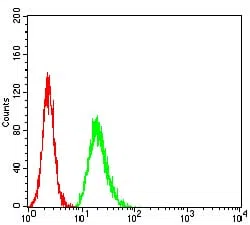
TCF4 Mouse Monoclonal Antibody
Size:50μL Price:$168
Size:100μL Price:$300
Application:ELISA,FC
Reactivity:Human
Conjugate:Unconjugated
Optional conjugates: Biotin, FITC (free of charge). See other 26 conjugates.
Gene Name:TCF4
Size:100μL Price:$300
Application:ELISA,FC
Reactivity:Human
Conjugate:Unconjugated
Optional conjugates: Biotin, FITC (free of charge). See other 26 conjugates.
Gene Name:TCF4
SKU:
AMM81804
Detail
Summary
Performance
Immunogen
Application
Background
This gene encodes transcription factor 4, a basic helix-loop-helix transcription factor. The encoded protein recognizes an Ephrussi-box ('E-box') binding site ('CANNTG') - a motif first identified in immunoglobulin enhancers. This gene is broadly expressed, and may play an important role in nervous system development. Defects in this gene are a cause of Pitt-Hopkins syndrome. In addition, an intronic CTG repeat normally numbering 10-37 repeat units can expand to >50 repeat units and cause Fuchs endothelial corneal dystrophy. Multiple alternatively spliced transcript variants that encode different proteins have been described.
Research Area