
Extracellular Matrix Dynamics
The extracellular matrix (ECM) is a three-dimensional macromolecular network composed of collagens, proteoglycans, glycosaminoglycans, elastin, fibronectin, laminins, along with many other proteins and glycoproteins. This network of macromolecules provides a dynamic microenvironment that supports cell and tissue function, and undergoes continuous remodeling during both normal development and disease.
Remodeling of the ECM can alter the relative balance of macromolecules within distinct ECM subcompartments, with important functional consequences; for example, changes to the relative amounts of COL1A1 and COL3A1 in the interstitial ECM, or COL4A1 and laminins in the basement membrane, can influence cell-matrix interactions, and/or disrupt cellular signaling events. Fibronectin functions as a physical and functional bridge between many different ECM components, including collagens, growth factors, and cell surface integrins, and thus plays a critical role in facilitating ECM remodeling.
Matricellular proteins (MCPs) are another important group of ECM proteins. MCPs can be categorized into 6 distinct subgroups: centralized coordination network (CCN), thrombospondin (THBS), secreted protein acidic and rich in cysteine (SPARC), tenascin (TN), small integrin-binding ligand N-linked glycoprotein (SIBLING), and γ-carboxyglutamate (Gla)-containing proteins. CCN1 (CYR61), SPARC, tenascin C, periostin, and thrombospondin-1 are among the most well-studied of this group. All are non-structural ECM proteins that interact with structural ECM proteins, in part to regulate the rigidity of the ECM. They also play important roles in matrix-cell communication by engaging with cell surface receptors and integrins to elicit intracellular responses. The dysregulation of MCP expression has been associated with the development of numerous disease states, including cancer and fibrosis.
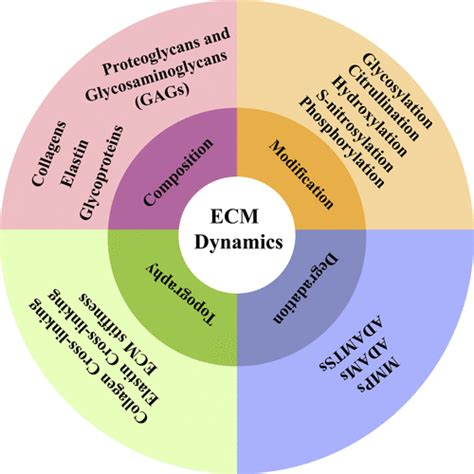
Dynamic regulatory network of ECM in terms of composition, chemical modification, degradation metabolism, and spatial structure
Relevant antibodies
| Catalog# | Product Name | Reactivity | Application |
|---|---|---|---|
| AMRe09208 | Collagen I alpha 1 (15S16) Rabbit Monoclonal Antibody | Human,Mouse,Rat | WB,IP |
| AMRe18788 | Tenascin C (7E16) Rabbit Monoclonal Antibody | Human,Mouse,Rat | WB,IHC-P,IF-P |
| AMRe21132 | Thrombospondin 1 Rabbit Monoclonal antibody | Human,Mouse,Rat | WB,IHC,IF,IP,ELISA |
| AMRe21368 | Fibronectin Rabbit Monoclonal antibody | Human,Mouse,Rat | WB,IHC,IF,IP,ELISA |
| AMRe21611 | Collagen IV Rabbit Monoclonal antibody | Human | WB,IHC,IF,IP,ELISA |
| AMRe87000 | SPARC (DGR19422) Rabbit mAb | Human | WB, FC, IP |
| AMRe21414 | Periostin Rabbit Monoclonal antibody | Human | WB,IHC,IF,IP,ELISA |
| APS0635 | HRP-conjugated Polyclonal Goat Anti-Rabbit IgG(H+L) Secondary Antibody | Rabbit | ELISA, WB, Dot blot |
| AMRe21597 | Collagen III Rabbit Monoclonal antibody | Human,Mouse,Rat | WB,IHC,IF,IP,ELISA |
| AMRe87527 | CCN1 (DGR16698) Rabbit mAb | Human | WB, ICC/IF, FC, IP |
| AMre80004 | GAPDH (12R9) Rabbit Monoclonal Antibody | Human,Mouse,Rat,Rabbit,Dog,Monkey | WB,ELISA |
Related Products
References
- Bonnans C, Chou J, Werb Z. Remodelling the extracellular matrix in development and disease. Nat Rev Mol Cell Biol. 2014 Dec;15(12):786-801. [PMID: 25415508].
- Theocharis AD, Manou D, Karamanos NK. The extracellular matrix as a multitasking player in disease. FEBS J. 2019 Aug;286(15):2830-2869. [PMID: 30908868].
- Gerarduzzi C, Hartmann U, Leask A, Drobetsky E. The Matrix Revolution: Matricellular Proteins and Restructuring of the Cancer Microenvironment. Cancer Res. 2020 Jul 1;80(13):2705-2717. CAN-18-2098. Epub 2020 Mar 19. [PMID: 32193287].
- Zollinger AJ, Smith ML. Fibronectin, the extracellular glue. Matrix Biol. 2017 Jul;60-61:27-37. 2016.07.011. Epub 2016 Aug 3. [PMID: 27496349].
- Feng D, Gerarduzzi C. Emerging Roles of Matricellular Proteins in Systemic Sclerosis. Int J Mol Sci. 2020 Jul 6;21(13):4776. [PMID: 32640520].
 | Flora Flora is a technical support expert at EnkiLife, familiar with immunology and neuroscience, dedicated to providing customers with high-quality product combinations and technical support to help achieve research in neurodegenerative diseases and other neuroscience areas. |