
NF-κB Non-Canonical Pathway
Introduction to NF-κB Non-Canonical Pathway
Transcription factors of the nuclear factor κB (NF-κB)/Rel family play a pivotal role in inflammatory and immune responses. There are five family members in mammals: RelA, RelB, c-Rel, NF-κB1 (p105/p50) and NF-κB2 (p100/p52). Both p105 and p100 are proteolytically processed by the proteasome to produce p50 and p52, respectively. The p50 and p52 products form dimeric complexes with Rel proteins. While p50 associates with many of the NF-κB family members, p52 tends to form dimers primarily with RelB. A plethora of stimuli such TNFα and LPS induce the canonical NF-κB pathway, characterized by the activation of the classical IκB Kinase (IKK) complex (containing IKKα, IKKβ, IKKγ, and ELKS), which then phosphorylates inhibitory IκB molecules, targeting them for rapid degradation through a ubiquitin-proteasome pathway.
The noncanonical pathway, triggered by BAFF, CD40L, and certain other stimuli, is based on the inducible phosphorylation and proteasome-mediated partial degradation of NF-κB2 p100 to p52, a process regulated by the NF-κB Inducing Kinase (NIK) and IKKα, but not IKKβ or IKKγ. NIK phosphorylates IKKα at Ser176/180 and p100 at Ser866/870, then recruits IKKα to p100 where IKKα phosphorylates additional residues in the N- and C-terminus, leading to the ubiquitination and processing of p100. The TNF Receptor Associated Factor molecules TRAF2 and TRAF3 have been shown to be negative regulators of the noncanonical pathway, and their differential binding to receptors may also play a role in determining whether transduced signals activate the canonical pathway, noncanonical pathway, or both. TRAF3 promotes the rapid turnover of NIK in resting cells, and its activation-induced degradation is a key regulatory point in the pathway. This pathway is required for B cell maturation and activation, proper architecture of peripheral lymphoid tissue, and safeguards against autoimmunity.
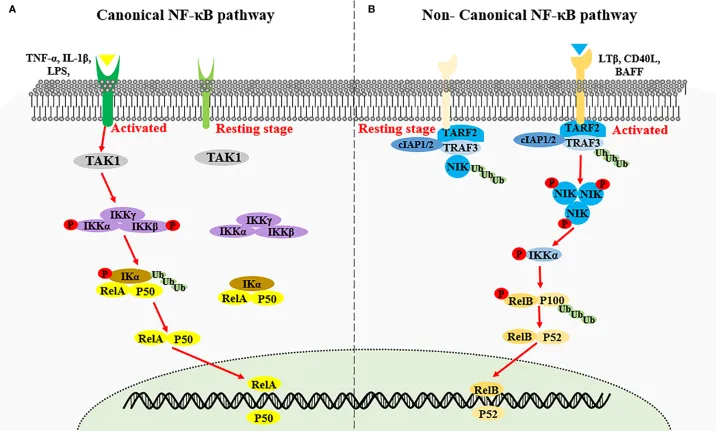
Activation of canonical NF-κB signaling and non-canonical NF-κB signaling
Relevant Antibodies
| Catalog# | Product Name | Reactivity | Application |
|---|---|---|---|
| AMRe21333 | IKK α Rabbit Monoclonal antibody | Human,Mouse,Rat | WB,IHC,IF,IP,ELISA |
| AMRe21179 | NFkB-p100 Rabbit Monoclonal antibody | Human,Mouse,Rat | WB,IF,IP,ELISA |
| AMM82287 | MAP3K14 Mouse Monoclonal Antibody | Human | IHC,FC,ELISA |
| AMRe21141 | RelB Rabbit Monoclonal antibody | Human,Mouse,Rat | WB,IHC,IF,IP,ELISA |
| AMRe19183 | TRAF2 (15T4) Rabbit Monoclonal Antibody | Human,Mouse,Rat | WB,IHC-P,ICC/IF,FC,IP,IF-P |
| AMRe87619 | TRAF3 (DGR32487) Rabbit mAb | Human,Mouse,Rat | WB |
| APS0635 | HRP-conjugated Polyclonal Goat Anti-Rabbit IgG(H+L) Secondary Antibody | ||
| AMre80004 | GAPDH (12R9) Rabbit Monoclonal Antibody |
Related Products
References
- Baeuerle PA, Baltimore D. NF-kappa B: ten years after. Cell. 1996 Oct 4;87(1):13-20.[PMID: 8858144].
- Baeuerle PA, Henkel T. Function and activation of NF-kappa B in the immune system. Annu Rev Immunol. 1994;12:141-79.[PMID: 8011280].
- Ghosh S, Karin M. Missing pieces in the NF-kappaB puzzle. Cell. 2002 Apr;109 Suppl:S81-96. [PMID: 11983155].
- Liao G, Zhang M, Harhaj EW, Sun SC. Regulation of the NF-kappaB-inducing kinase by tumor necrosis factor receptor-associated factor 3-induced degradation. J Biol Chem. 2004 Jun 18;279(25):26243-50. [PMID: 15084608].
Liao G, Zhang M, Harhaj EW, Sun SC. Regulation of the NF-kappaB-inducing kinase by tumor necrosis factor receptor-associated factor 3-induced degradation. J Biol Chem. 2004 Jun 18;279(25):26243-50. [PMID: 15084608].
Lu X, Chen Q, Liu H, Zhang X. Interplay Between Non-Canonical NF-κB Signaling and Hepatitis B Virus Infection. Front Immunol. 2021 Sep 29;12:730684.[PMID: 34659217].
 | Flora Flora is a technical support expert at EnkiLife, familiar with immunology and neuroscience, dedicated to providing customers with high-quality product combinations and technical support to help achieve research in neurodegenerative diseases and other neuroscience areas. |