
Uncovering the Secrets of ELISA Solid-Phase Carriers
As one of the most classic experiments in life sciences research, ELISA marks the starting point of many scientific research journeys. And the first step of this journey is to make your target protein firmly "settle" on the ELISA plate. This process is what we call "coating".
Have you ever wondered how these invisible and intangible proteins are adsorbed in the tiny plastic wells, as if by magic? What kind of "glue" is used to hold them in place? Today, we will use a vivid analogy to take you through the mystery of this process, leaving no questions unanswered.
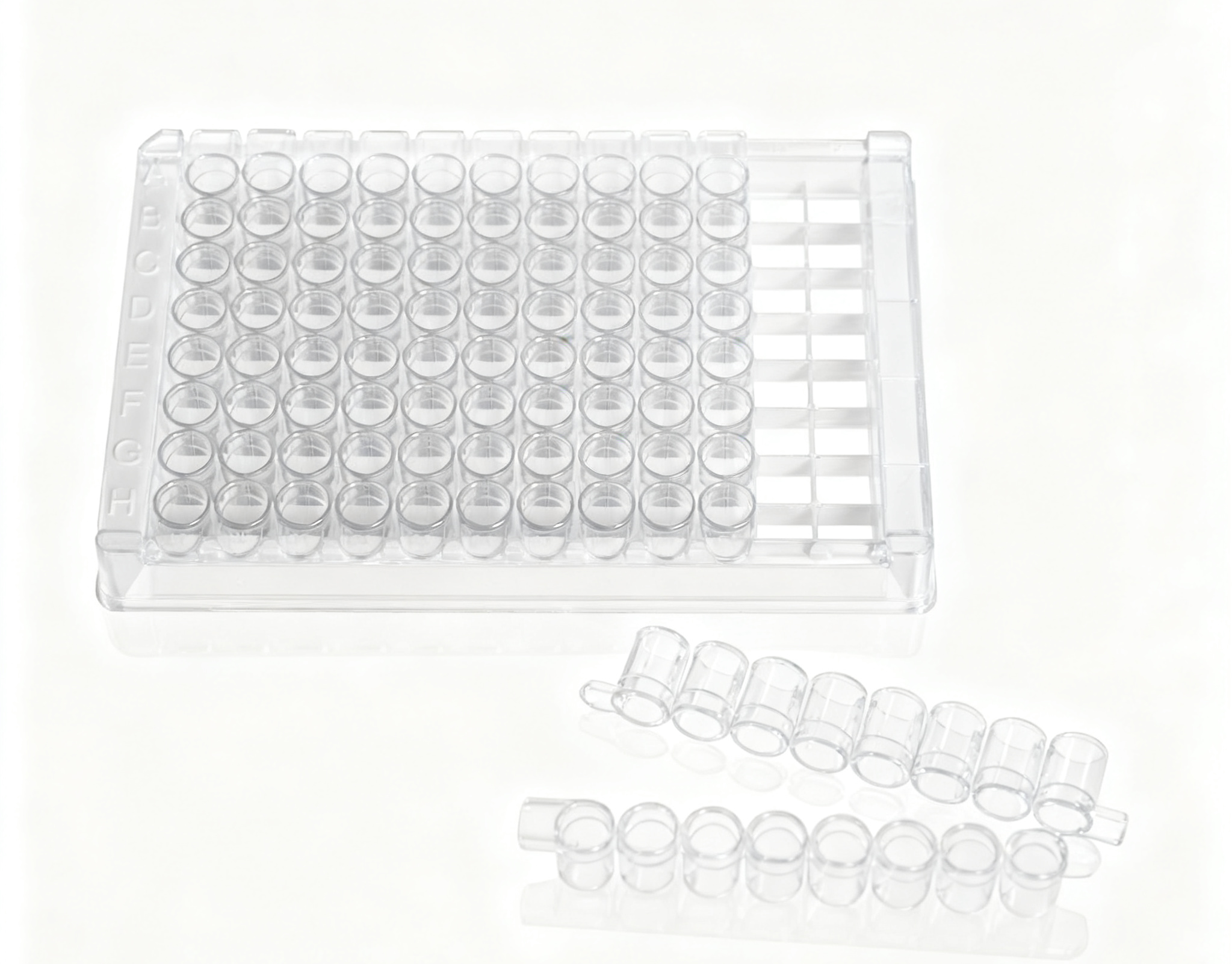
The most commonly used solid-phase carrier in ELISA is the microplate made of polystyrene. Its adsorption of proteins forms the basis of the entire detection system, and the core principle behind this lies in the non-covalent interactions between the surface of the solid-phase material and protein molecules—interactions that mainly rely on two types of non-specific, mild physical forces:
1. The main force: Hydrophobic Interaction
To give an example, you must have seen oil droplets on water—they always gather into a large oil bead instead of dispersing and dissolving in water. This is the hydrophobic effect behind "oil and water don't mix"—substances that "dislike water" tend to cluster together to reduce contact with water molecules.
Polystyrene is a typical hydrophobic polymer material with a surface lacking polar groups, exhibiting strong hydrophobicity. In the three-dimensional structure of proteins, the interior usually contains hydrophobic amino acids, while the exterior is dominated by hydrophilic groups. However, in an aqueous environment, due to the "hydrophobic effect," some hydrophobic regions of protein molecules are exposed on the surface, becoming key sites for binding to solid-phase carriers. When you add an aqueous solution containing proteins into an ELISA well, the hydrophobic regions on the protein molecules will instinctively seek out the ELISA plate, which also has hydrophobic regions. Thus, the hydrophobic regions of the protein and the hydrophobic surface of the ELISA plate instantly "click" and bind tightly. This is the primary driving force behind protein adsorption onto solid-phase carriers.
2. The auxiliary force: Electrostatic Interaction
In ELISA, both protein molecules and the surface of the ELISA plate may carry weak positive or negative charges in a specific pH buffer. The attractive force generated between these positive and negative charges, similar to that of tiny magnets, further strengthens the binding of proteins to the plate. Though not as strong as hydrophobic interaction, this force also contributes to the stability of adsorption.
Key Conditions Affecting Adsorption
Coating Buffer: Carbonate buffer (pH 9.0-9.6) and phosphate buffer (pH 7.2-7.4) are commonly used. Under alkaline conditions, most proteins carry more negative charges, which helps enhance the electrostatic attraction between proteins and the polystyrene surface. Surfactants (e.g., Tween-20) should be avoided in the coating buffer, as they will compete for binding sites and reduce adsorption efficiency. High-concentration organic solvents and strong chelating agents should also be excluded, to prevent damage to proteins or disruption of surface interactions.
Coating Concentration: A higher protein concentration is not always better. Excessively high protein concentration can cause molecules to stack into multiple layers on the plate, which instead reduces the binding efficiency of subsequent antibodies and may even increase non-specific background. It is necessary to determine the optimal coating concentration through preliminary experiments.
Coating Temperature: Common options include 1–2 hours at 37°C or overnight incubation at 4°C. At 37°C, molecular motion is increased, which promotes the contact between proteins and the carrier surface and shortens the adsorption equilibrium time. Adsorption at 4°C is slower, yet it can reduce protein denaturation, making it suitable for coating sensitive proteins.
Gentle Operation: Since this is physical adsorption, overly vigorous rinsing should be avoided in subsequent washing steps to prevent the already bound proteins from being "washed off".
Our ELISA kit uses a microplate made of polystyrene, which is pre-coated with antibodies and can be stored at low temperatures for up to one year, saving researchers valuable experimental time. Visit the website to view ELISA kit.
 | Felicia Felicia is a technical support specialist at EnkiLife, with extensive professional experience in antibody development, optimization, and ELISA assay design and application. She is committed to assisting our clients in selecting suitable antibody products, optimizing ELISA experimental protocols, and resolving technical challenges encountered in the process, thereby supporting the smooth progress of their life science research projects. |