
Two paths to antibody tools: monoclonal vs. polyclonal advantages and choices
In 2024, the global monoclonal antibodies (mAbs) drug market is projected to hit $230 billion, accounting for half of the biopharmaceutical market. As a milestone in biomedicine, mAb drugs have revolutionized disease diagnosis and treatment, addressing previously intractable diseases. This breakthrough stems from monoclonal antibody technology, which replaced the traditional polyclonal antibodies (pAbs) production model. Today, let's talk about "monoclonal antibodies" and " polyclonal antibodies ". The core difference between polyclonal antibodies and monoclonal antibodies is the type of antibody and application scenario. Both have their own focuses in scientific research, medical care and other fields.
Differences in the types of monoclonal antibodies and polyclonal antibodies
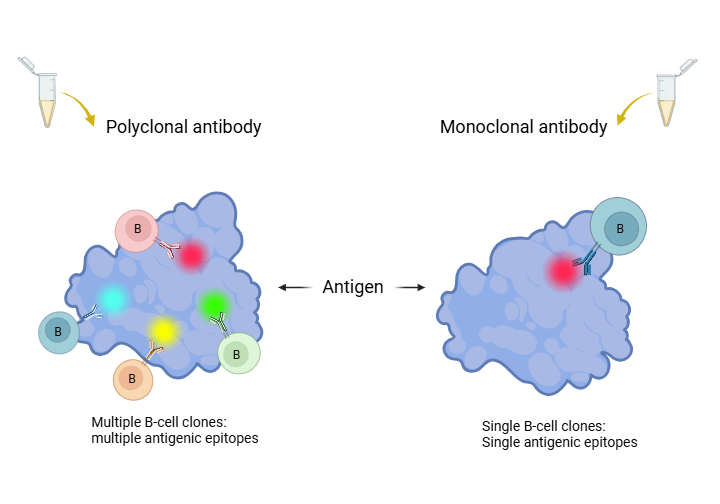
First of all, what is a monoclonal antibody? The molecular structure on the antigen that can cause the body to produce antibodies is called the antigen determinant, also known as the epitope. An antigen can have many different antigenic determinants, so the body can produce many different antibodies. Antibodies produced by cloning a single B cell that recognize only a specific epitope of an antigen are called monoclonal antibodies.
Polyclonal antibodies produced by multiple B lymphocyte clones, stimulated by multiple antigenic determinants, and can bind to multiple epitopes of antigens. In a sense, pAbs are mixtures of multiple mAbs. Whether it is antibodies isolated and purified from human or animal serum, they are basically a combination of antibodies that recognize different epitopes and are produced by different B cell clones.
The preparation technology of mAbs was elaborated in detail in the previous article, so it will not be repeated here. The preparation process of mAbs is relatively complex and time-consuming, whereas the preparation of pAbs is less cumbersome. For pAbs preparation, it only requires directly injecting the antigen into an animal for immunization. After 3-4 rounds of immunization, when the serum titer is confirmed to be qualified by ELISA, blood is collected and centrifuged to obtain the supernatant. Polyclonal antibodies can be obtained after purifying the supernatant. Therefore, the preparation cycle of pAbs is shorter than that of mAbs, and their price is also lower than that of mAbs.
Differences in the Applications of Monoclonal Antibodies and Polyclonal Antibodies
Both mAbs and pAbs have their own distinct characteristics and advantages. Monoclonal antibodies exhibit high specificity and are less prone to cross-reactivity. Once a hybridoma cell line or recombinant expression system is successfully established, theoretically unlimited production can be achieved, which ensures the stability of supply and the possibility of large-scale application. However, if the recognized antigenic epitope is damaged, the experimental results will be significantly affected—this is also one of the drawbacks of monoclonal antibodies.
The advantage of polyclonal antibodies is that they can recognize multiple epitopes, which are especially suitable for detecting less abundant proteins, and can play a natural role in signal amplification in some detection methods. Therefore, it is less specific, and even if polyclonal antibodies are prepared with the same antigen, there will be differences between batches. Therefore, when using polyclonal antibodies for immunoassays, it is easier to cause background. By identifying multiple epitopes, even if a few epitopes are destroyed or the conformation of the antigen is altered, the results of the experiment will not be affected.
Polyclonal antibodies are more widely used in the field of secondary antibodies because their characteristics and functional requirements of secondary antibodies are highly adaptable. Secondary antibodies need to identify the Fc segment of the primary antibodies, and pAbs can recognize multiple epitopes of the primary antibodies, and can combine multiple primary antibodies molecules or multiple sites of the same primary antibodies at the same time, forming a signal superposition effect, significantly improving detection sensitivity, and adapting to WB, IHC and other experiments that require enhanced signals. The epitope coverage of pAbs to primary antibodies is comprehensive, and even if the primary antibodies undergoes slight conformational changes due to sample treatment, it can still bind stably and can be adapted to different species and subtypes of primary antibodies, with strong versatility. The pAbs preparation process is simple, the cycle is short, and the cost is low, which can meet the needs of large-scale production of secondary antibodies.
In the vast world of life sciences, antibodies are the cornerstone of conducting research, diagnosis, and treatment. However, when faced with the options of "monoclonal" and "polyclonal", many people get confused. How are they different? How do I choose for my experiment? To help you understand clearly and make informed decisions, we've compiled a list of the most frequently asked questions about monoclonal and polyclonal antibodies.
Q1:Why is it necessary to distinguish between monoclonal antibodies and polyclonal antibodies?
A1:The core purpose of distinguishing between monoclonal antibodies and polyclonal antibodies is to select the most suitable antibody tool for different experimental needs and application scenarios based on the inherent differences in their properties. This ensures the accuracy, reproducibility, and efficiency of research while reducing cost input.
Q2:Between monoclonal antibodies and polyclonal antibodies, which one is better?
A2:This is an extremely common question, but the answer is: there is no absolute "better," only "more suitable."
Think of them as two different armies: a polyclonal antibody is like a "joint army" – it is a mixture of multiple antibodies that can attack multiple different weak points (epitopes) on the same enemy (antigen). Its advantages lie in its strong "firepower" and high adaptability; it will not easily lose track of the target due to a little "disguise" of the enemy (protein denaturation). A monoclonal antibody (mAb), on the other hand, is like an "elite sniper" – it is a highly pure antibody that only attacks one extremely specific weak point (a single epitope) on the enemy. Its advantages are ultimate precision (it never harms innocent targets by mistake), and every "sniper" is identical, acting with a high degree of consistency.
Q3:What is the primary principle when making a choice?
A3:When you need quantitative, standardized, and highly specific results, monoclonal antibodies should be prioritized.
When you need to capture, screen, or detect denatured proteins and pursue high signal intensity, polyclonal antibodies usually perform excellently. Additionally, when purchasing antibodies, you must pay attention to the product description to confirm whether the product meets the requirements of your experiment.
Specific Recommendations for Application Scenarios
| Application scenarios | Common choice | Note |
|---|---|---|
Western blot(WB) | Monoclonal antibodies: suitable for precise targeting of target proteins Polyclonal antibodies: suitable for low-abundance protein initial screening | Polyclonal antibodies can be used to determine protein expression in the initial assay, and then monoclonal antibodies can be used for more accurate quantification or functional identification. |
Immunohistochemistry (IHC) | Both are acceptable | Monoclonal antibody: stable batch, uniform staining results, and in line with the standardization requirements of clinical diagnosis. Polyclonal antibodies: multi-epitope recognition, better tissue penetration, and easier to capture localization signals. |
immunofluorescence(IF) | Both are acceptable | Monoclonal antibodies need to match the host species of fluorescent secondary antibodies. Polyclonal antibodies need to optimize the blocking conditions to reduce non-specific fluorescence. |
Immunoprecipitation(IP) | Monoclonal antibodies: Accurately identify and capture a single target protein Polyclonal antibodies: More effective when gripping multiple interacting molecules or protein complexes | The reproducibility of monoclonal antibodies is good. Polyclonal antibodies are more favorable when they interact weakly. |
ELISA | Monoclonal antibodies + polyclonal antibodies or paired monoclonal antibodies | In the "sandwich-method", monoclonal antibodies are usually used as capture antibodies and polyclonal antibodies are used as detection antibodies. |
Lateral flow immunochromatography assay(LFIA) | Monoclonal antibodies + polyclonal antibodies or paired monoclonal antibodies | Monoclonal antibodies can be used as capture antibodies and polyclonal antibodies can be used as detection antibodies. |
Flow cytometry (FACS) | Monoclonal antibodies | Clonal stability and consistent fluorescent labeling are required. |
Antibody-Dependent Cellular Cytotoxicity Assay (ADCC) | Monoclonal antibodies | Monoclonal antibodies can precisely bind to target cell surface antigens, activate immune cell killing functions, and the results are reproducible. |
Protocol for Functional Study of Specific Epitopes(Phosphorylation Site Detection Kit and so on) | Monoclonal antibodies | Monoclonal antibodies can specifically identify specific modification sites of antigens (such as phosphorylation, methylation) and accurately analyze epitope function. |
Q4:Which one is more stable in cases of antigen variation or cross-species detection?
A4:In antigen variation detection, polyclonal antibodies perform better. For monoclonal antibodies, it is necessary to verify whether they can still recognize the variant epitopes. Moreover, polyclonal antibodies have a higher probability of cross-species application; monoclonal antibodies can achieve cross-species detection targeting conserved epitopes in sequences, but sequence alignment and actual testing are required.
Q5:I've heard that polyclonal antibodies have significant batch-to-batch variation. Will this affect my research? How should I address this?
A5:Yes, this is likely the biggest "pain point" of polyclonal antibodies, especially for long-term research projects that require reproducibility. An antibody batch that works exceptionally well may yield completely different results when replaced with a new batch after the original is used up. However, there is no need to worry: reputable companies conduct strict quality control (QC) on different batches and provide batch-specific verification data.
Additionally, based on the research cycle and experimental dosage, you can purchase the total amount of antibodies needed to cover the entire study at one time and store them properly to avoid changing batches midway. If the experimental cycle is long (e.g., more than 1 year), the antibody can be aliquoted into small volumes and stored frozen at -20°C. This avoids a decrease in titer caused by repeated freeze-thaw cycles, further ensuring the stability of the antibody from the same batch.
Q6:When there is no signal or high background, what should be prioritized for troubleshooting?
A6:No signal: Antigen abundance/degradation, epitope masking, antibodies not suitable for the application, secondary antibody labeling failure, improper sample processing. High background: Insufficient blocking/washing, excessively high antibody concentration, cross-reactivity, mismatched host recognition by the secondary antibody. Rapid solutions: Gradient dilution, complete controls, switching clones, or trying polyclonal antibodies.
Q7: Are monoclonal antibodies and polyclonal antibodies the final choices? What new technologies can we expect in the future?
A7:They are classic tools, but far from the end. In the future, breakthroughs will be made in the direction of intelligent design and functional expansion. Core new technologies include: Nanobodies, with their small molecular weight, can penetrate solid tumors and the blood-brain barrier, and also have the advantages of low-cost and high-efficiency expression. AI-driven synthetic antibodies do not require animal immunization and can significantly shorten the development cycle. Multi-specific antibodies can synergistically target multiple sites to improve the efficacy of treatment and detection. In addition, the integration of antibodies with drugs and imaging labels enables the integration of diagnosis and treatment; personalized antibodies, through single-cell technology and gene editing, can adapt to individual needs. These technologies will promote antibodies from traditional targeting tools to more precise and flexible intelligent diagnosis and treatment platforms, making them a core force in precision medicine.
We offer over 7,000 types of Recombinant Rabbit Monoclonal Antibody, 7,000 of polyclonal antibodies, and more than 400 types of secondary antibodies for your selection. We are sure to meet your experimental needs. Visit our website to find the perfect antibody for your target.
 | Felicia Felicia is a technical support specialist at EnkiLife, with extensive professional experience in antibody development, optimization, and ELISA assay design and application. She is committed to assisting our clients in selecting suitable antibody products, optimizing ELISA experimental protocols, and resolving technical challenges encountered in the process, thereby supporting the smooth progress of their life science research projects. |