
Traumatic Brain Injury Biomarker
Traumatic brain injury (TBI) is a worldwide health issue that significantly affects the patient as well as their family. Annual total cost of nonfatal TBI in 2016 was $40.6 billion in the United States. In addition to acute brain injury, even mild cases, can lead to cognitive impairment and long-term psychiatric changes. More long term, TBI patients exhibit lower resilience to neurodegenerative disease-associated pathology. Treatment of TBI is made more difficult due to lack of reliable biomarkers to detect TBI. Several proteins are of interest, which are candidates for measurement in blood after TBI. Glial fibrillary acidic protein (GFAP) is an astrocytic intermediate filament protein. As a cytoskeletal protein, GFAP helps provide structural support to astrocytes, which provide metabolic support to neurons and maintains the blood brain barrier. The number and size of astrocytes, in a process called astrogliosis, is also positively correlated with brain injury. Also abundantly expressed in astrocytes, S100B is commonly used as an astrocytic marker and is positively correlated with TBI. Neurofilament-L (NfL) and tau are part of the neuronal cytoskeleton that provide structure to axons. Axons are covered by a multi-layered membrane called the myelin sheath. Myelin basic protein (MBP) is enriched in myelin and helps maintain its structure. UCHL1 and Enolase-2 are ubiquitin hydrolases and glycolytic enzymes, respectively, that are enriched in neurons. PSD95 is an adaptor protein enriched at postsynaptic sites in neurons. After brain injury, neuron-enriched proteins, as well as proteins that maintain neuronal/axonal integrity, can be measured in the blood, reflecting neuronal damage.
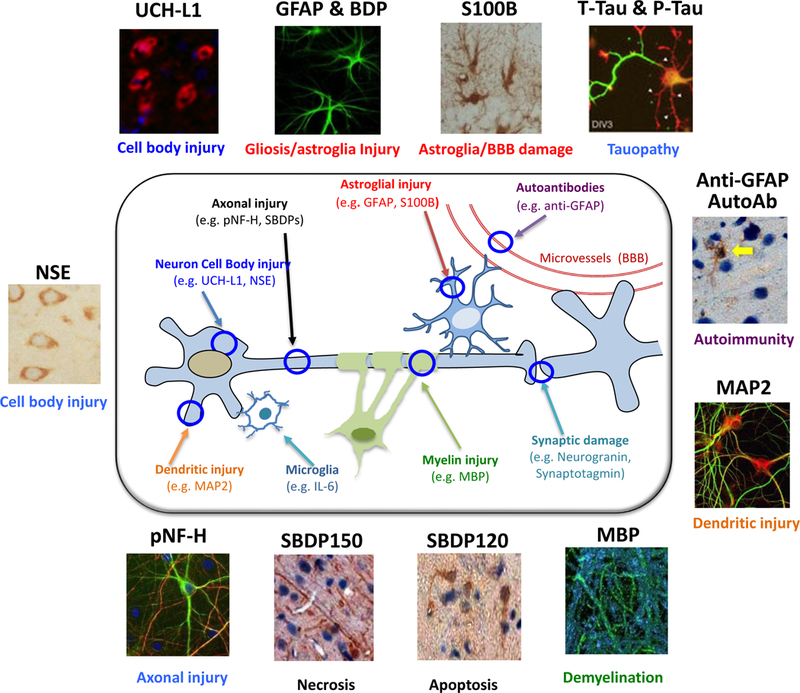
Graphic representation of major TBI protein biomarkers linked to different pathophysiologic processes in TBI.
Relevant Antibodies
| Catalog# | Product Name | Application | Reactivity |
|---|---|---|---|
| AMRe21476 | GFAP Rabbit Monoclonal antibody | WB,IHC,IF,IP,ELISA | Human,Mouse,Rat |
| AMRe02563 | S100B Rabbit Monoclonal Antibody | WB,IHC-P,IP | Human,Mouse,Rat |
| AMRe21539 | PGP9.5 Rabbit Monoclonal antibody | WB,IHC,IF,IP,ELISA | Human,Mouse,Rat |
| AMM82586 | NEFL Mouse Monoclonal Antibody | WB,IHC,FC,ELISA | Human,Mouse,Rat,Rabbit |
| AMRe14909 | NSE (9L10) Rabbit Monoclonal Antibody | WB,ICC/IF,FC,IP | Human,Mouse,Rat |
| AMM83407 | Tau Mouse Monoclonal Antibody | WB,IHC | Human |
| AMRe14275 | Myelin Basic Protein (4M5) Rabbit Monoclonal Antibody | WB,IHC-P,IF-P | Human,Mouse,Rat |
| AMRe16592 | PSD95 (13H1) Rabbit Monoclonal Antibody | WB,IHC-P,IP,IF-P | Human,Mouse,Rat |
| APS0631 | HRP-conjugated Polyclonal Goat Anti-Mouse IgG(H+L) Secondary Antibody | ELISA,WB,Dotblot | Mouse |
| APS0635 | HRP-conjugated Polyclonal Goat Anti-Rabbit IgG(H+L) Secondary Antibody | ELISA,WB,Dotblot | Mouse |
| AMRe80004 | GAPDH (12R9) Rabbit Monoclonal Antibody | WB,ELISA | Human,Mouse,Rat,Rabbit,Dog,Monkey |
Related Products
- Antibody Labeling Kit
- Western Blot Kits
- Super-sensitive ECL chemiluminescent reagent
- IHC Kit
- TSA mIHC Kits
References
- Miller, G.F. et al. (2021) Med Care 59, 451-455.
- van Amerongen, S. et al. (2022) Dement Geriatr Cogn Dis Extra 12, 122-130.
- Alouani, A.T. and Elfouly, T. (2022) Biomedicines 10, 2472.
- Yang, Z. and Wang, K.K. (2015) Trends Neurosci 38, 364-74.
- Steinmüller, J.B. et al. (2022) Neurotrauma Rep 3, 447-455.
- Lippa, S.M. et al. (2022) Front Neurol 13, 816625.
- Wang KK. et al. (2018) 18(2):165-180.
 | Voisey Voisey is a technical support specialist at EnkiLife, proficient in immunology and cell biology. She is committed to providing customers with professional and efficient technical support. Additionally, she is involved in research on customers' fields of study and designs highly cost-effective solutions for them. |