
Coating: The "Fundamental Engineering" of ELISA Experiments
Coating is the process of immobilizing specific antibodies or antigens on the surface of a solid-phase carrier. Its quality directly affects the sensitivity, specificity, and reproducibility of the experiment. It is equivalent to building an "exclusive reaction platform" for subsequent antigen-antibody reactions. Its specific functions are reflected in three aspects:
1. Ensuring reaction specificity: By immobilizing specific targets (antibodies/antigens), it ensures that only the corresponding antigens/antibodies in the sample will bind in subsequent steps, reducing interference from non-specific adsorption and avoiding false positive results.
2. Enhancing detection sensitivity: Optimized coating conditions enable the surface of the solid-phase carrier to bind the target uniformly and in sufficient quantity, maximizing the capture of the substance to be detected in the sample. Even if the concentration of the substance to be detected in the sample is extremely low, it can still be detected through subsequent enzymatic reactions.
3. Maintaining experimental stability: A standardized coating process ensures that the amount of immobilized target is consistent across each plate and each well, reducing intra-batch and inter-batch variations.
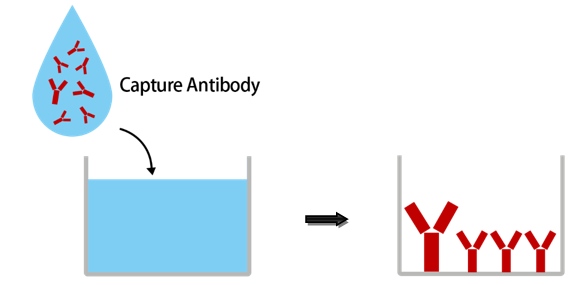
Key Influencing Factors of the Coating
1. Selection of coating substances: It should be determined according to the detection purpose — when detecting antigens, specific antibodies are used for coating; when detecting antibodies, the corresponding antigens are used for coating. If small-molecule substances (such as hormones, drugs) are to be detected, the small molecules need to be coupled with carrier proteins before coating; otherwise, the small molecules cannot be effectively immobilized on the surface of the solid-phase carrier.
2. Coating Buffer and pH Value: Carbonate buffer (pH 9.0-9.6) and phosphate buffer (pH 7.2-7.4) are commonly used, as they can promote the adsorption of proteins onto the well plate through electrostatic interactions. A deviation of the pH value from the optimal range will lead to a decrease in coating efficiency. For example, when the pH is too low, proteins carry a positive charge, which weakens their adsorption force with the well plate.
3. Coating Concentration and Incubation Conditions: The concentration is usually 1-10 μg/mL, while the coating concentration for small-molecule antigens may need to be higher (e.g., 5-20 μg/mL) due to their small molecular weight and fewer binding sites. There are two incubation methods: overnight incubation at 4°C or incubation at 37°C for 2 hours. After incubation, the plate should be washed 3 times with a washing solution (PBS containing 0.05% (v/v) Tween-20) to remove unbound coating substances and prevent subsequent interference.
4. Auxiliary Role of the Blocking Step: After coating, there are still "empty sites" on the well plate surface that are not bound to the coating substance. These sites need to be blocked with a blocking solution (5% non-fat milk or 1% BSA) to prevent non-specific adsorption of subsequent enzyme-labeled secondary antibodies or foreign proteins in the sample. Incomplete blocking will lead to increased signal in blank wells and a higher CV value, which is also a key step that is easily overlooked in the operation of uncoated kits.
Pre-coated ELISA Kit
The operation process of uncoated kits is complex. For preliminary preparation, users need to prepare coating buffers and blocking solutions by themselves, and conduct preliminary experiments to find the appropriate coating concentration. They also need to perform coating operations (either overnight at 4°C or for 2 hours at 37°C) and blocking operations (for 1 hour at 37°C). The total time required for the entire experiment is as long as 12-24 hours, after which steps such as sample addition and incubation can be carried out. Thus, their efficiency is much lower than that of pre-coated kits. Moreover, the operation is more difficult. Users need to strictly control key parameters such as coating concentration, incubation temperature, and time. Even slight variations in these parameters may lead to experimental errors. This places high demands on the operational skills and experience of laboratory personnel, and it is easy for novices to obtain unstable results during operation.
EnkiLife provides customers with pre-coated ready-to-use kits, featuring the following advantages:
1. No need for step optimization — detection can be easily conducted by following the experimental procedures, with short time consumption and simple operation.
2. The kits offer excellent reproducibility, high sensitivity and strong specificity, which can ensure the accuracy of detection results.
3. Stable performance enables them to meet the needs of continuous detection.
4. Routine samples have been validated, providing references for customers' experiments.
5. Fast delivery and thoughtful service, along with professional technical support for detection.
If you have any needs, please contact us. Visit the website to view ELISA kit.
 | Felicia Felicia is a technical support specialist at EnkiLife, with extensive professional experience in antibody development, optimization, and ELISA assay design and application. She is committed to assisting our clients in selecting suitable antibody products, optimizing ELISA experimental protocols, and resolving technical challenges encountered in the process, thereby supporting the smooth progress of their life science research projects. |