
Antibody Preparation FAQs - Animal Immunization
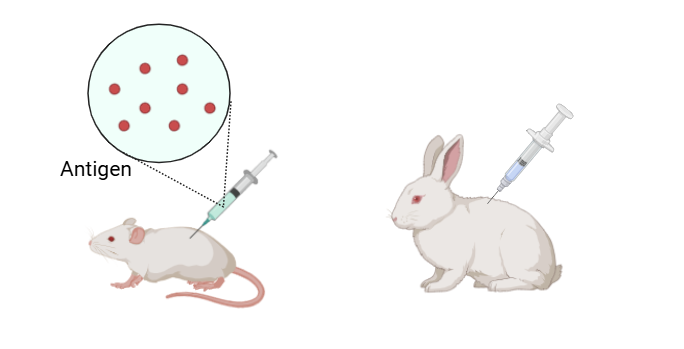
In the preparation of monoclonal antibodies and polyclonal antibodies, animal immunization is one of the core steps. Its purpose is to stimulate the animal's immune system to produce specific antibodies against the target antigen. The immunization procedures for the two types of antibodies share certain commonalities, but also exhibit differences due to their distinct preparation objectives.
1. Antigen Pretreatment
Protein antigens must ensure a purity of >90% to avoid interference with the immune response by impurity proteins. For small-molecule compounds or polypeptides, conjugation with carrier proteins (such as BSA or KLH) is required, and KLH is generally the preferred choice.
2. Selection of Experimental Animals
For polyclonal antibody preparation, New Zealand white rabbits, goats, sheep, and other animals are commonly used. Among them, rabbits are the most frequently chosen due to their moderate body size, stable immune response, and ease of blood collection. For specific antigens, guinea pigs, chickens, and other animals can also be selected. For monoclonal antibody preparation, BALB/c mice are the primary choice for immunization. If the antigen has weak immunogenicity, other strains such as rats can be used.
3. Adjuvants and Immunization Reagents
The commonly used adjuvants for immunization are Freund's Complete Adjuvant (FCA) and Freund's Incomplete Adjuvant (FIA). FCA contains inactivated Mycobacterium tuberculosis and has a strong immune-enhancing effect. It is generally used for the primary immunization. FIA does not contain bacterial components, which reduces inflammatory reactions in animals and is suitable for subsequent booster immunizations. Before immunization, Freund's Adjuvant must be fully emulsified with the antigen in advance to form stable emulsion droplets and prevent stratification.
4. Animal Housing Environment
The housing environment must meet SPF grade standards. The temperature should be controlled at 20–25°C, humidity at 40%–60%, and the light cycle set to 12 hours of light/12 hours of darkness. Sterility of feed and drinking water must be ensured to avoid external stressors affecting the immunization effect.
5. Titer Determination
Typically, after 3 rounds of immunization, blood is collected from the mouse tail tip or rabbit ear marginal vein, and the serum antibody titer is detected using an indirect ELISA. Once the titer meets the standard, a booster immunization without adjuvant is administered 3–5 days before cell fusion or serum collection, usually via intraperitoneal injection or intravenous injection.
Why is there no antibody titer after immunization or low antibody titer after immunization?
1. Whether the molecular weight and immunogenicity are appropriate, the molecular weight is preferably not less than 20kDa. Whether small-molecule compounds or polypeptides are conjugated to a carrier protein. For protein-based antigens, it is advisable to confirm whether the protein is degraded via SDS-PAGE prior to immunization.
2. If the antibody titer fails to meet the standard after three rounds of immunization, the number of booster immunizations should be increased. If there is still no improvement in the titer, it is necessary to re-evaluate the current antigen design, antigen quality, and immunization protocol.
3. For subcutaneous immunization, inject at as many points and sites as possible; if necessary, it can be combined with intraperitoneal injection and tail vein injection.
4. To measure immune titer, indirect ELISA is generally used, which requires determining the conditions for ELISA determination, such as the optimal concentration of antigen coating, the concentration of secondary antibodies, and the sensitivity of the substrate. For different concentrations of antigens, the evaluation of their potency needs to be treated differently. When the antigen coating concentration is too low, there may be an insufficient antigen, resulting in a weakened or even undetectable binding signal, and even if the actual antibody concentration is not low, it may be misjudged as a low titer.
Notes:
1. The immune dose should be set reasonably to avoid immune tolerance caused by too high a dose, and too low cannot induce an effective response. Regular doses are sufficient.
2. The entire process of antigen preparation, emulsification, and injection should be conducted in a sterile environment. Operators must wear sterile gloves and masks to prevent microbial contamination of the antigen or infection of animals.
3. Within 30 minutes after immunization, closely observe the animal to check whether there is redness, swelling, ulceration, or nodules at the injection site. Observe changes in animal diet, drinking, and weight, and if there is a decrease in appetite or sudden weight loss, it is necessary to check for infection or immune abnormalities.
4. To reduce the impact of individual animal differences, at least 3 animals in the immune group. For monoclonal antibody preparation, select the animal with the highest titer for cell fusion. For polyclonal antibody preparation, mix sera from multiple animals to avoid the impact of low response in a single individual on the overall effect.
5. After the antibody titer reaches its peak 3–5 days after booster immunization, blood collection or spleen harvesting should be performed promptly to prevent a decline in antibody titer due to excessive delay.
The core differences in immune effects of different immune animals
Experimental Animals | Characteristics and Advantages | Limitations | Antibody Yield | ||
BALB/c Mice | It exhibits a stable response to most antigens, can directionally produce highly specific IgG1 antibodies, and features a short immunization cycle and easy operation, making it suitable for accelerating experimental progress. It is commonly used in monoclonal antibody preparation. Its fusion efficiency with myeloma cells is extremely high; hybridoma clones rarely undergo chromosome loss, and can still stably secrete antibodies after subsequent subculture and cryopreservation, reducing the risk of antibody secretion loss. | Its antibody yield is low, with only 0.1–0.2 mL of serum obtained per blood collection. It is not suitable for polyclonal antibody preparation. The antibody concentration in the culture supernatant of hybridoma cells is low. Its response to antigens with weak immunogenicity is relatively weak, and the occurrence of non-specific clones is likely. | Low | ||
Rat | The diversity of B cells is higher than that of mice, and the tolerance threshold for conserved antigens and weak immunogenic antigens is higher, and they can activate specific B cells more efficiently, such as rats immunized with human conserved proteins, and are easy to obtain blocking antibodies. It is suitable for the preparation of immunogenic monoclonal antibodies or functional blockade assays. The proliferation ability of hybridoma cells is strong, and the concentration of antibodies in the culture supernatant can reach 50-200 μg/mL, and the antibody yield is more guaranteed when subsequently expanded culture. | Myeloma cells are less selective and the fusion efficiency is lower than that of mice. The immunization cycle is longer, the operation is more complex than mice, and the cost of raising rats is higher than that of mice, so the experimental cycle and cost will increase. Serum yield is not as good as in rabbits. | Moderate | ||
Rabbit | Its immune system is relatively complex, the clonal diversity of B cells is far higher than that of mice and rats, allowing it to recognize more antigenic epitopes. Additionally, its immune response intensity is high, with serum antibody titers reaching 10⁶–10⁷— the highest among the three animal species. It is suitable for scenarios requiring antibodies with high specificity and high affinity, and is the first choice for polyclonal antibody preparation. | Rabbit hybridoma technology maturity is lower than that of mice, there are few myeloma cell lines available, fusion efficiency is low, and hybridoma clones are less stable and prone to loss of antibody secretion. In addition, rabbits have a long immunization cycle, high feeding costs, and high experimental thresholds and costs. | High | ||
Goat/Sheep | The antibody yield is extremely high, making it the animal of choice for large-scale multibody preparation. A single blood collection volume of up to 50-200mL is suitable for industrial-grade antibody production. The immune response to macromolecular antigens is stable, and the antibody lasts for a long time. | The immunization cycle is long, and booster immunization may reach the potency. The feeding cost is high, and professional large animal breeding facilities and blood collection personnel are required. Antibody cross-reactivity is relatively high, requiring additional purification optimization for scenarios with high specificity requirements. | Very high |
We offer over 7,000 types of Recombinant Rabbit Monoclonal Antibody, 7,000 of polyclonal antibodies, and more than 4000 of Mouse Monoclonal Antibody for your selection. We are sure to meet your experimental needs. Visit our website to view Recombinant Monoclonal Antibody.
 | Felicia Felicia is a technical support specialist at EnkiLife, with extensive professional experience in antibody development, optimization, and ELISA assay design and application. She is committed to assisting our clients in selecting suitable antibody products, optimizing ELISA experimental protocols, and resolving technical challenges encountered in the process, thereby supporting the smooth progress of their life science research projects. |