
UV Induced DNA Damage Response
Exposure to ultraviolet radiation (UV) has a profound impact on human health and disease. Low level UV exposure induces the production of vitamin D and is a key regulator of calcium metabolism. Conversely, overexposure to UV is associated with an increased risk of cancer, immunosuppression, and many eye disorders, such as cataracts. Photons of UV light can directly damage DNA causing thymine dimers and other pyrimidine dimers between adjacent bases. Free radicals and reactive oxygen species induced by UV exposure also result in DNA lesions and have been linked to malignant melanoma. DNA damage from replicative stress and genotoxic agents like UV activate the ATR-mediated checkpoint pathway and stimulate DNA repair, cell cycle arrest, and apoptosis. ATR recruitment to sites of DNA damage and activation depends, at least in part, on interaction with the complex of single-stranded DNA, Replication Protein A (RPA), and direct binding to the ATR-associated adapter protein, ATRIP. In addition, the Rad17-RFC and Rad9-Rad1-Hus1 protein complexes are independently recruited with TopBP1 to fully activate the checkpoint response . BRIT1 (MCPH1) is required for UV-induced formation of ATR, RPA, and p-Rad17 foci at sites of DNA damage and may regulate the expression of several DNA damage response proteins. Once activated, ATR phosphorylates a number of mediators, including histone H2AX Ser139 and Chk1 kinase at Ser345. H2AX phosphorylation is a marker of DNA damage. Complete loss of H2AX results in reduced Chk1 activation and impaired survival of cells after UV exposure . Chk1 and Chk2 kinase activation is essential for checkpoint-mediated control of cell cycle progression. Checkpoint kinases stimulate cell cycle arrest by phosphorylation of a group of tyrosine phosphatases known as Cdc25A, Cdc25B, and Cdc25C. Both Chk1 and Chk2 kinases phosphorylate Cdc25C at Ser216, which promotes binding to 14-3-3 proteins and subsequent nuclear export of Cdc25C . This prevents Cdc25C from activating the Cdc2/cyclin B complex, which is required for entry into mitosis.
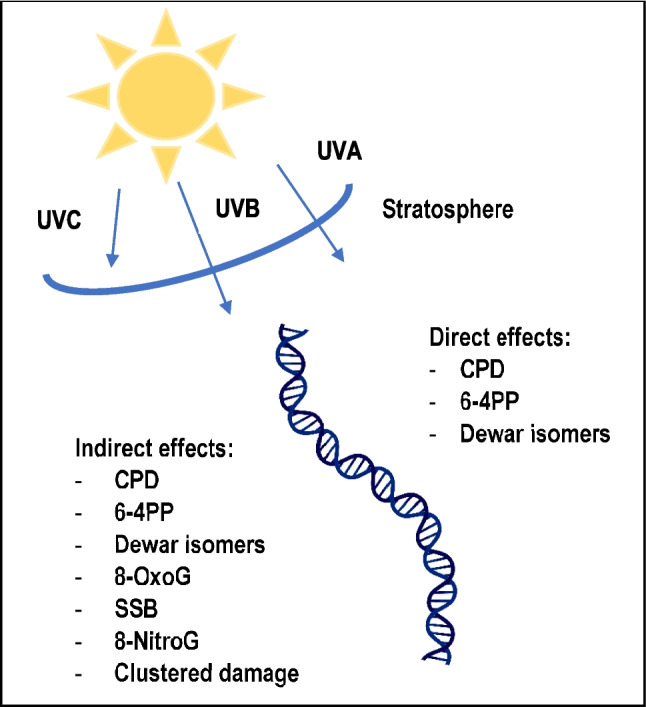
DNA damage induced by ecological UV radiation.
Relevant Antibodies
| Catalog# | Product Name | Application | Reactivity |
|---|---|---|---|
| AMRe21478 | Histone H2A.X (Phospho Ser139) Rabbit Monoclonal antibody | WB,IHC,IF,IP,ELISA | Human,Mouse,Rat |
| APRab04424 | Cdc25C (phospho Ser216) Rabbit Polyclonal Antibody | WB,IHC-P,IF-P,IF-F,ICC/IF,ELISA | Human,Rat,Mouse |
| APRab04456 | Chk1 (phospho Ser345) Rabbit Polyclonal Antibody | IHC-P,IF-P,IF-F,ICC/IF,ELISA | Human,Mouse,Rat |
| AMRe21449 | RPA32/RPA2 Rabbit Monoclonal antibody | WB,IHC,IF,IP,ELISA | Human,Mouse,Rat |
| AMRe84449 | ATRIP Rabbit Monoclonal | WB,ICC | Human,Mouse,Rat |
| APRab04285 | ATR (phospho Ser428) Rabbit Polyclonal Antibody | IHC-P,IF-P,IF-F,ICC/IF,ELISA | Human,Rat,Mouse |
| APRab13894 | Microcephalin Rabbit Polyclonal Antibody | WB,IHC-P,IF-P,IF-F,ICC/IF,ELISA | Human,Mouse |
| APS0635 | HRP-conjugated Polyclonal Goat Anti-Rabbit IgG(H+L) Secondary Antibody | ELISA,WB,Dotblot | Mouse |
| AMRe80004 | GAPDH (12R9) Rabbit Monoclonal Antibody | WB,ELISA | Human,Mouse,Rat,Rabbit,Dog,Monkey |
Related Products
· Super-sensitive ECL chemiluminescent reagent
· IHC Kit
References
- von Thaler, A.K. et al. (2010) Exp Dermatol 19, 81-8.
- Rastogi, R.P. et al. (2010) J Nucleic Acids 2010, 592980.
- Narayanan, D.L. et al. (2010) Int J Dermatol 49, 978-86.
- Zhou, B.B. and Elledge, S.J. (2000) Nature 408, 433-9.
- Zou, L. and Elledge, S.J. (2003) Science 300, 1542-8.
- Zou, L. et al. (2002) Genes Dev 16, 198-208.
- Mordes, D.A. and Cortez, D. (2008) Cell Cycle 7, 2809-12.
- Rai, R. et al. (2006) Cancer Cell 10, 145-57.
- Peng, G. et al. (2009) Nat Cell Biol 11, 865-72.
- Lin, S.Y. et al. (2010) Yonsei Med J 51, 295-301.
- Lin, S.Y. et al. (2005) Proc Natl Acad Sci U S A 102, 15105-9.
- Revet, I. et al. (2011) Proc Natl Acad Sci U S A 108, 8663-7.
- Mailand, N. et al. (2000) Science 288, 1425-9.
- Sanchez, Y. et al. (1997) Science 277, 1497-501.
- Matsuoka, S. et al. (1998) Science 282, 1893-7.
- Blasina, A. et al. (1999) Curr Biol 9, 1-10.
- Furnari, B. et al. (1999) Mol Biol Cell 10, 833-45.
- Sánchez AG. et al. (2025) Biophys Rev, 17(2):537-545.
 | Voisey Voisey is a technical support specialist at EnkiLife, proficient in immunology and cell biology. She is committed to providing customers with professional and efficient technical support. Additionally, she is involved in research on customers' fields of study and designs highly cost-effective solutions for them. |