
Types of Recombinant Antibodies and Their Generation Methods
Recombinant antibodies can be classified into five major categories: chimeric antibodies, humanized antibodies, fully human antibodies, small-molecule antibodies, and bispecific antibodies.
Chimeric Antibodies
The constant regions and variable regions of chimeric antibodies are derived from different species respectively. A common type of chimeric antibody is formed by combining the variable regions of animal-derived antibodies with the constant regions of human-derived antibodies. Its core lies in retaining target specificity while reducing partial immunogenicity, and it is a major type of early recombinant antibodies.
Characteristics of Chimeric Antibodies
1. The variable regions of the antibody are of animal origin, which retain the antibody’s specificity and affinity for antigens.
2. Nearly 70% of the antibody is human-derived, which largely reduces the antibody’s heterogeneity. Among this human-derived part, the Fc fragment can effectively mediate antibody-dependent cellular cytotoxicity (ADCC) and complement-dependent cytotoxicity (CDC).
3. Different antibody types, subtypes, sizes, and modification sites can be selected according to specific needs.
4. Through mature plasmid construction systems and protein expression platforms, the target antibody can be obtained efficiently and in large quantities.
Production Methods of Chimeric Antibodies

Humanized Antibodies
Chimeric antibodies cannot completely solve the problem of the HAMA (human anti-mouse antibody reaction) response. To address this, functional humanized antibodies have been developed by grafting the complementarity-determining regions (CDR) from the variable regions of murine antibodies into the framework regions (FR) of the variable regions of human antibodies.
Characteristics of Humanized Antibodies
1. Based on chimeric antibodies, humanized antibodies further expand the human-derived region in the antibody molecule, with the proportion of humanization reaching 80%-90%. This reduces the heterologous rejection response of the human body when the antibody is applied.
2. The process of CDR binding to antigens is affected by the FR. The binding of animal-derived CDR to human FR may alter the spatial structure of the original CDR of the antibody, thereby reducing the affinity of the recombinant antibody to the antigen. In the design process of FR reconstruction, the three-dimensional model of the animal-derived variable region should serve as a guide, while homology analysis and molecular modeling provide essential auxiliary methods to minimize the impact on the CDR domains. This mainly involves two steps: a. Selecting human-derived FR from homologous antibodies or antibody consensus sequences. b. Identifying the amino acids that play a key role in the FR based on published information.
Production Methods of Humanized Antibodies

Fully Human Antibodies
To further address the issue of immunogenicity, researchers have developed fully human antibody technology. Fully human antibodies are constructed entirely from human genes, eliminating any animal-derived components, and thus exhibit lower immunogenicity in clinical therapy.
First, gene knockout technology is used to inactivate the animal’s endogenous antibody genes, resulting in a deficiency of animal antibody genes. Subsequently, human antibody genes are introduced into these antibody gene-deficient animals via transgenesis or chromosome transfer technology. The animals then express human antibodies, achieving complete humanization of the antibodies. However, this method is technically challenging, costly, and still carries the risk of human rejection. Consequently, phage display technology has emerged as an alternative solution.
In this approach, the variable region genes of human antibodies are inserted into appropriate positions within the structural genes of phage coat proteins. As the phage coat proteins are expressed, the human antibody variable regions are co-expressed and, along with the reassembly of phages, displayed on the phage surface. Finally, fully human antibodies are obtained through the screening of the display library and subsequent expression in host cells.
Characteristics of Fully Human Antibodies
The greatest advantage of fully human antibodies lies in the almost complete elimination of immunogenicity. Since they are constructed entirely from human genes, these antibodies are compatible with the human immune system, thereby reducing patients' immune responses to the antibodies. In addition, fully human antibodies generally exhibit high affinity and stability, so their therapeutic effects are relatively long-lasting. They are the most important targets in antibody drug research and development, have broad applications in the treatment of diseases and cancers, and possess significant research and production value.
Production Methods of Fully Human Antibodies

Small-molecule Antibodies
Small-molecule antibodies, also known as mini-antibodies or single-domain antibodies, are developed by engineering intact antibody molecules to achieve "miniaturization." This modification enhances their penetration ability and overcomes the challenge of difficulty in reaching deep-seated tumor cells within solid tumors.
Composed of a single antibody domain, they are usually derived from the heavy chain variable region (VH) or light chain variable region (VL). The existing types of small-molecule antibodies include Fab, Fv, scFv, SdAb, minibodies, and nanobodies.
Characteristics of Small-molecule Antibodies
1. The molecular weight of small-molecule antibodies is only 1/12 to 1/2 that of intact antibodies. They exhibit strong penetrability, high affinity, and specificity, enabling them to bind to target proteins with high selectivity and reduce impacts on non-targets.
2. Since they only contain a single antibody domain, small-molecule antibodies have a simpler structure, making them easy to engineer and optimize.
3. Their expression and purification in various expression systems are relatively straightforward, which facilitates large-scale production.
Production Methods of Small-molecule Antibodies

Bispecific Antibodies
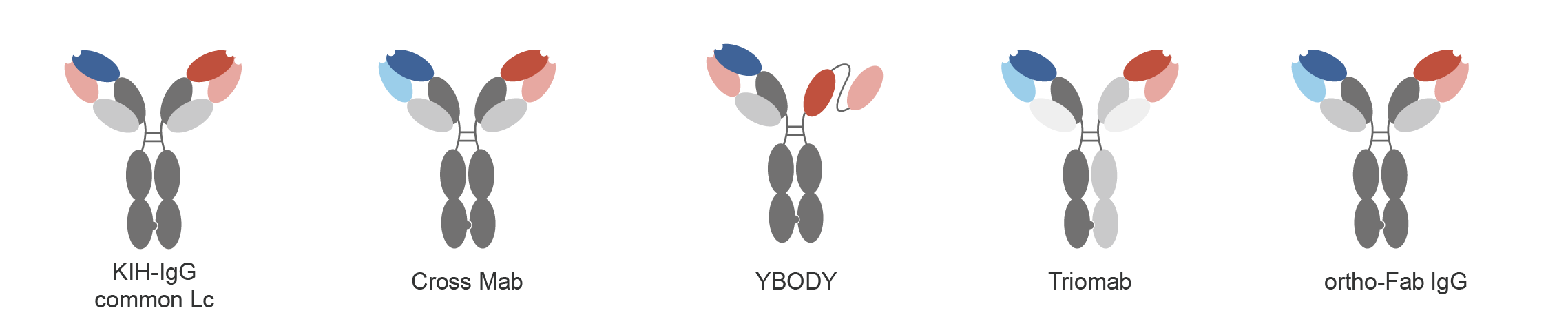
Bispecific antibodies (BsAbs) are antibodies with two specific antigen-binding sites, capable of binding to two different antigens simultaneously. They are important research targets in the field of antibody drugs and have achieved remarkable efficacy in cancer treatment.
By connecting "effector cells/molecules" with "diseased cells", bispecific antibodies actively guide immune responses or signal regulation. For example, they can directionally recruit T cells to the vicinity of tumor cells, activate the killing function of T cells, and thereby achieve the dual effects of "precision targeting + immune activation".
Classification of Bispecific Antibodies
| Structural Type | Core Characteristics | Typical Example |
|---|---|---|
| IgG-like bispecific antibody | Retains the Fc segment of traditional antibodies, possesses effector functions such as ADCC and CDC, with pharmacokinetics closer to natural antibodies. | Bispecific antibody targeting HER2 and CD3 |
| Non-IgG-like bispecific antibody | Lacks an Fc segment, has a smaller molecular size (mostly single-chain or double-chain fragments), exhibits strong tissue penetration, but has a shorter half-life, which needs to be extended via PEG modification or albumin fusion. | Bispecific T-cell engager (BiTE) |
| Fusion protein-based bispecific antibody | Fuses antibody fragments with other functional proteins (e.g., cytokines, enzymes), and possesses both targeting ability and additional biological functions (e.g., immunoregulation, enzymatic hydrolysis). | Antibody-cytokine fusion bispecific antibody |
Common Bispecific Antibody Structures
With Fc region
Without Fc region

Recombinant rabbit monoclonal antibodies launched by EnkiLife provide efficient solutions for scientific research needs, leveraging an extensive portfolio of over 7,000 varieties and full compatibility with diverse experimental scenarios.Visit our website to view Recombinant Rabbit Monoclonal Antibody.
 | Felicia Felicia is a technical support specialist at EnkiLife, with extensive professional experience in antibody development, optimization, and ELISA assay design and application. She is committed to assisting our clients in selecting suitable antibody products, optimizing ELISA experimental protocols, and resolving technical challenges encountered in the process, thereby supporting the smooth progress of their life science research projects. |