
TSA staining (Tyramide Signal Amplification) is a highly sensitive immunohistochemical (IHC) or immunofluorescence (IF) signal amplification technique that achieves multi-level signal amplification through enzyme catalyzed reactions.
Principle
1. Basic steps:
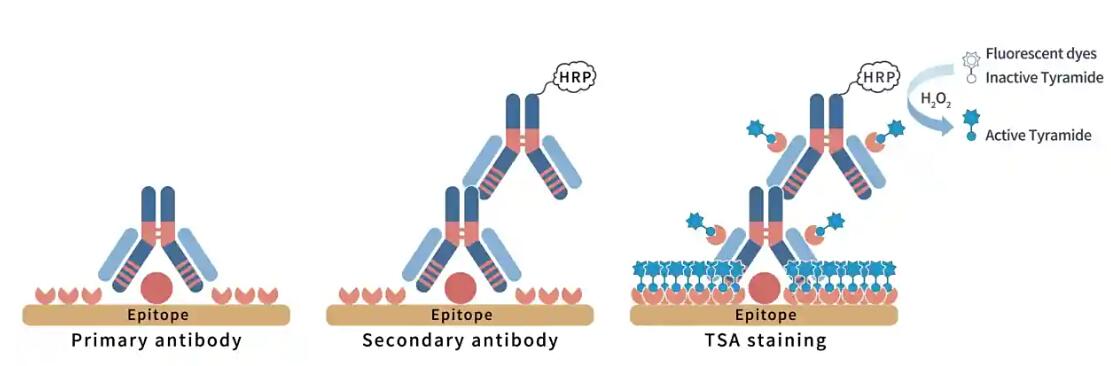
-After the primary antibody binds to the target antigen, a horseradish peroxidase (HRP) labeled secondary antibody is added.
-HRP catalyzes the activation of tyramine derivatives in the presence of hydrogen peroxide.
2. Signal amplification mechanism:
-Activated tyramine molecules instantly covalently bind to proteins near antigen sites (such as tyrosine residues), forming a large amount of marker deposition (such as fluorescent dyes).
-Each HRP molecule can catalyze the production of hundreds of casein markers, achieving geometric amplification of the signal.
Advantages
1. Ultra high sensitivity:
-Can detect low abundance antigens (10-100 times more sensitive than traditional IHC), suitable for trace samples or weakly expressed targets.
2. Strong compatibility:
-Can be combined with fluorescence, color rendering (DAB), or metal labeling to adapt to various microscopes or imaging systems.
3. Multiple markers:
-By using different tyramine derivatives (such as different fluorescent dyes) step by step, multiple targets (4 to 8 types) can be co located in the same specimen.
4. Unrestricted species of primary antibody:
-The required primary antibody is not limited by species origin, improving the applicability of multiple staining.
5. Reduce background noise:
-The covalent binding of casein is limited to the vicinity of the antigen, reducing non-specific diffusion and improving signal-to-noise ratio.
6. Save primary antibodies:
-The amplification effect allows for a reduction in the amount of primary antibody used and lowers costs.
Applications
1. Research field:
-Neuroscience: Detecting synaptic proteins or neurotransmitters sparsely expressed in neurons.
-Cancer: Identifying rare biomarkers (such as PD-L1) in the tumor microenvironment.
-Developmental Biology: Observing low abundance signaling molecules in embryonic tissues.
-Other
2. Clinical diagnosis:
-Enhance the detection rate of weakly expressed antigens in pathological sections (such as HER2/neu expression in breast cancer).
-Used for detecting circulating tumor cells (CTCs) or minimal residual lesions (MRD).
3. Special samples:
-Paraffin sections and frozen sections of samples fixed with formalin or paraformaldehyde solution (with appropriate antigen retrieval).
Precautions
-Sequential labeling control: When performing multiple staining, it is necessary to design the order of antibodies and tyramine reasonably (usually staining low expression proteins first).
-Antigen repair and antibody elution: Excessive repair can cause detachment, while insufficient antibody elution can cause cross reactivity.
TSA staining technology has become an important tool for complex biological research and precision medical diagnosis due to its excellent sensitivity and flexibility.