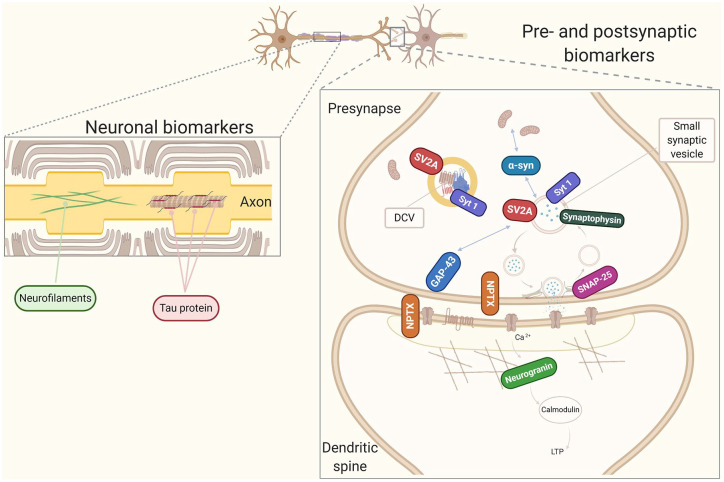
 Synapses are the site for brain communication where information is transmitted between neurons and stored for memory formation. Synaptic degeneration is a global and early pathogenic event in neurodegenerative disorders with reduced levels of pre- and postsynaptic proteins being recognized as a core feature of Alzheimer’s disease (AD) pathophysiology. Together with AD, other neurodegenerative and neurodevelopmental disorders show altered synaptic homeostasis as an important pathogenic event, and due to that, they are commonly referred to as synaptopathies.
Pre-synaptic Markers: Pre-synaptic markers are primarily associated with synaptic vesicles, the active zone, and neurotransmitter release machinery.
Post-synaptic Markers: Post-synaptic markers concentrate in the PSD, a protein-dense region beneath the post-synaptic membrane that anchors receptors and signaling complexes.
Co-localization of pre- and post-synaptic markers (e.g., SYP + PSD-95) is the gold standard for identifying functional synapses in imaging studies. These markers are indispensable for studying synaptic development, plasticity, and pathology in neurodegenerative and neuropsychiatric disorders.
Product List
| Target | Catalog# | Product Name | Reactivity | Application |
|---|---|---|---|---|
| SLC1A3 | AMRe21573 | EAAT1 Rabbit Monoclonal Antibody | Human,Mouse,Rat | WB,IHC,ICC/IF,ELISA,IP |
| GAP43 | AMRe02021 | GAP43 Rabbit Monoclonal Antibody | Human,Mouse,Rat | WB,IHC,IF,IP,ELISA |
| VAMP2 | AMRe02751 | VAMP2 Rabbit Monoclonal antibody | Human,Mouse,Rat | WB,ICC/IF,IP |
| SNAP25 | AMRe03813 | SNAP25 Rabbit Monoclonal Antibody | Human,Mouse,Rat | WB,ICC/IF,IP |
| Synapsin I | AMRe87652 | Synapsin I Rabbit Monoclonal Antibody | Human,Mouse,Rat | WB,IHC,ICC/IF,FC,IP |
| SYN1 | AMRe01536 | Phospho-Synapsin I (Ser9) Rabbit Monoclonal Antibody | Human,Rat | WB,IHC |
| HOMER1 | AMRe02110 | Homer1 Rabbit Monoclonal antibody | Mouse,Rat | WB,IP |
| Gephyrin | AMRe87797 | Gephyrin Rabbit Monoclonal Antibody | Human,Mouse,Rat | WB,IHC |
| EAAT1 | AMRe86984 | EAAT1 Rabbit Monoclonal Antibody | Human,Mouse,Rat | WB,IHC,ICC/IF |
| TNC | AMRe18788 | Tenascin C (7E16) Rabbit Monoclonal Antibody | Human,Mouse,Rat | WB,IHC,IF-P |
| Phospho-Synapsin I (Ser553) | AMRe87651 | Phospho-Synapsin I (Ser553) Rabbit Monoclonal Antibody | Human,Mouse,Rat | WB |
| SYN1 | AMRe21272 | Synapsin I Rabbit Monoclonal Antibody | Human,Mouse,Rat | WB,IHC,ICC/IF,ELISA,IP |
| SYP | AMRe21043 | Synaptophysin Rabbit Monoclonal Antibody | Human,Mouse,Rat | WB,IHC,ICC/IF,ELISA,IP |
| VAMP2 | AMRe87717 | VAMP2 Rabbit Monoclonal Antibody | Human,Mouse,Rat | WB,IHC,IP |
| Syntaxin 1A | AMRe87650 | Syntaxin 1A Rabbit Monoclonal Antibody | Human,Mouse,Rat | WB,IHC,ICC/IF,FC,IP |
| SLC17A7 | AMRe19788 | VGLUT1 (15S18) Rabbit Monoclonal Antibody | Human,Mouse,Rat | WB,IHC,ICC/IF,IP |
| GAP43 | AMRe21353 | GAP43 Rabbit Monoclonal Antibody | Human,Mouse,Rat | WB,IHC,ICC/IF,ELISA,IP |
| Phospho-PSD95 (Ser418) | AMRe87124 | Phospho-PSD95 (Ser418) Rabbit Monoclonal Antibody | Human,Mouse,Rat | WB |
| PSD95 | AMRe87373 | PSD95 Rabbit Monoclonal Antibody | Human,Mouse,Rat | WB,IHC,IP |
| DLG4 | AMRe16592 | PSD95 (13H1) Rabbit Monoclonal Antibody | Human,Mouse,Rat | WB,IHC,IF,IP,ELISA |
| Gephyrin | AMRe87803 | Gephyrin Rabbit Monoclonal Antibody | Human,Mouse,Rat | WB,IHC,ICC/IF,FC |
| GPHN | AMRe11405 | Gephyrin (8G16) Rabbit Monoclonal Antibody | Human,Mouse,Rat | WB,IHC,IF-P |
| GRIN1 | AMRe14756 | NMDAR1 (5R10) Rabbit Monoclonal Antibody | Human,Mouse,Rat | WB,ICC/IF |
| Glutamate Receptor 1 (AMPA subtype) | AMRe86817 | Glutamate Receptor 1 (AMPA subtype) Rabbit Monoclonal Antibody | Human,Mouse,Rat | WB,IP |
Related Products
Super-sensitive ECL chemiluminescent reagent
References
- Fluid Biomarkers for Synaptic Dysfunction and Loss. Camporesi E, et al. Biomark Insights. 2020. [PMID: 32913390]
- Synaptic dysfunction and glial activation markers throughout aging and early neurodegeneration: a longitudinal CSF biomarker-based study. Muñoz-García MI, et al. Mol Neurodegener. 2025. [PMID: 41102691]
- Synaptic activity and strength are reflected by changes in the post-synaptic secretory pathway. Gürth, CM., et al. Sci Rep 10, 20576 (2020).