
Common Questions About ELISA
ELISA is one of the fundamental experiments in immunology, and most researchers in the life sciences field are familiar with it. Owing to its characteristics of strong specificity, high sensitivity, and accurate quantitation, ELISA technology is widely applied in both basic scientific research and clinical diagnosis.
The ELISA assay involves few steps and a short workflow. Additionally, kits are accompanied by highly informative instruction manuals, allowing even beginners to master the procedure quickly. However, it is important not to underestimate this technique. Similar to other basic immunological experiments such as WB and IHC, ELISA is easy to learn but difficult to excel at. While getting started is straightforward, achieving consistent and reliable results requires careful attention to detail. Therefore, we have compiled a list of common issues that may arise during ELISA experiments for your reference.
Q1: Can ELISA detect intracellular proteins?
A1: Yes, it can. Most indicators for ELISA are secreted proteins such as inflammatory factors and chemokines, and the supported sample types are mostly liquid samples like serum, plasma, and cell culture supernatants. If intracellular proteins need to be detected, the following steps should be taken: first, confirm whether the target indicator is expressed intracellularly; then, select an ELISA kit that supports the test sample. Next, lyse tissue samples or cell samples to extract intracellular proteins, and perform protein quantification to ensure that the total amount of protein loaded in each well is consistent.
Q2: Can ELISA detect DNA epigenetics?
A2: No, it cannot. ELISA is a technique that utilizes immunological principles to quantitatively detect protein expression. For the detection of DNA epigenetics—primarily focusing on DNA methylation—the ChIP technique is recommended.
Q3: Are the capture antibody and detection antibody the same antibody in a sandwich ELISA assay?
A3: No, they are not. In a double-antibody sandwich ELISA assay, both a capture antibody and a detection antibody are used. These two antibodies target different epitopes on the same antigenic protein, which allows them to bind to the antigen molecule simultaneously. This is also the reason why the double-antibody sandwich ELISA is not suitable for detecting targets such as small-molecule antigens and haptens.
Q4: Does the kit contain a capture antibody?
A4: In our ELISA kit, the capture antibody is pre-coated on the ELISA plate included in the kit. No separate capture antibody is provided. You can directly use the ELISA plate to incubate the diluted samples and standards.
Q5: In an ELISA experiment, what is an enzyme-conjugated antibody, and what is its target for recognition?
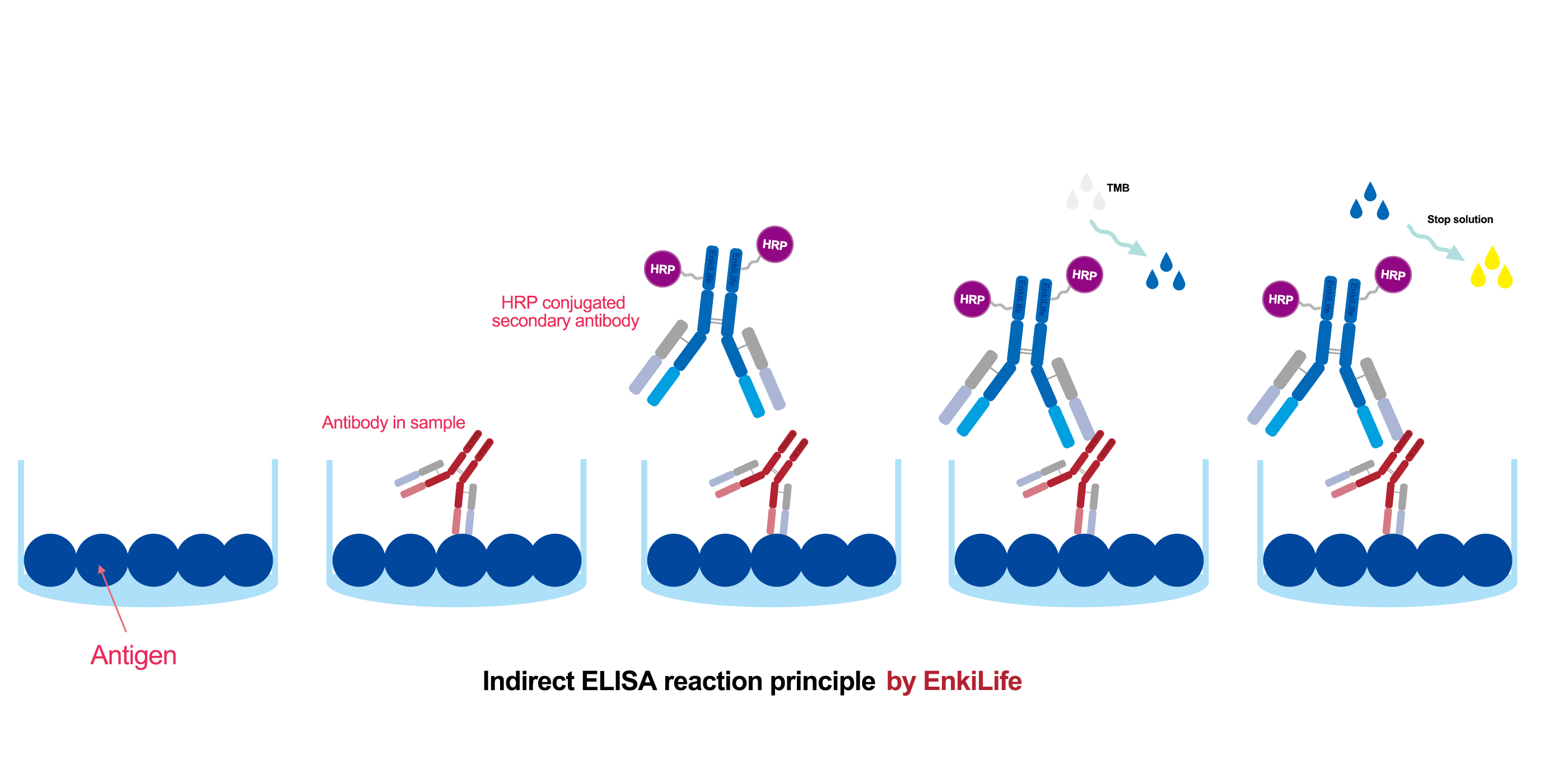
A5: This question requires specific analysis. In a direct ELISA, the enzyme-conjugated antibody directly recognizes the antigen, enabling detection. However, it lacks a secondary antibody to achieve signal amplification, resulting in low sensitivity. In an indirect ELISA, the enzyme-conjugated antibody acts as a secondary antibody and recognizes the detection antibody. Enzyme-conjugated antibodies are provided in all our kits.
Q6: Before conducting the experiment, how can I determine the range of inflammatory factors in the serum to be tested? And what range is considered high or low?
A6: This needs to be inferred based on literature. Generally, in samples from healthy individuals, the expression of inflammatory factors is very low, close to the lower detection limit of ELISA. Thus, the samples do not need to be diluted or can be diluted at a 1:1 ratio. If the samples are from patients with inflammatory diseases or experimental models (e.g., disease-induced animal models), you can refer to relevant literature and set dilution ratios of 1:10–100 (or higher) in a preliminary experiment. After detecting the preliminary experiment, determine the optimal concentration for the formal experiment.
Q7: In an ELISA experiment, when calculating the concentration of the detected antigen, how is the critical value determined?
A7: Based on the concentration measured from the standard curve, it is recommended that the value falls in the middle range of the standard curve. Ideally, the measured value should not exceed the upper and lower limits of the standard curve. If it exceeds these limits significantly, the accuracy of the calculation results will be affected, and it is recommended to adjust the dilution ratio.
Q8: How to choose between direct ELISA, indirect ELISA, sandwich ELISA, and competitive ELISA during an experiment?
A8: Regarding the types of ELISA, this article provides a detailed introduction “The types of ELISA”. Based on the classification method in this article, we will respectively explain the advantages, disadvantages, and selection principles of each method.
Although the direct ELISA has a short operational workflow and few experimental steps, each antigen molecule can only bind to one enzyme-conjugated antibody, resulting in limited signal amplification and relatively low sensitivity. Additionally, the primary antibody used in the experiment needs to be directly labeled with an enzyme, which leads to relatively high costs and increased operational difficulty. Therefore, the direct ELISA is suitable for rapid screening, preliminary qualitative analysis of antigens, or scenarios where detection antibodies are limited but easy to label.
In the indirect ELISA, one primary antibody molecule can bind to multiple enzyme-conjugated secondary antibody molecules, offering high sensitivity, good flexibility, and low cost. It is one of the commonly used ELISA types, especially suitable for antibody detection—such as the determination of titers of antibodies in serum.
Below, we will use a table to compare direct sandwich ELISA, indirect sandwich ELISA, direct competitive ELISA, and indirect competitive ELISA.
| ELISA Type | Direct Sandwich ELISA | Indirect Sandwich ELISA | Direct Competitive ELISA | Indirect Competitive ELISA |
|---|---|---|---|---|
| Key Reagent Requirements | Capture antibody and enzyme-conjugated detection antibody | Capture antibody and unlabeled detection antibody and enzyme-conjugated secondary antibody | Enzyme-conjugated antibody | Unlabeled antibody and enzyme-conjugated secondary antibody |
| Core Advantages | Fewer experimental steps No secondary cross-reactivity, suitable for complex samples Multiple targets can be detected simultaneously using detection antibodies conjugated with different enzymes | High sensitivity, suitable for low-abundance antigens No need to conjugate the detection antibody, low cost Strong versatility: a single detection antibody can be paired with secondary antibodies of different species to adapt to different enzyme types | Fewer experimental steps No secondary cross-reactivity, suitable for complex samples Only the sample antigen competes with the enzyme-conjugated antigen, no other interference | High sensitivity No need to conjugate the antibody, low cost Strong versatility: a single detection antibody can be paired with secondary antibodies of different species to adapt to different enzyme types |
| Application Scenarios | Rapid detection of high-abundance proteins Detection of high-background samples Simultaneous detection of multiple targets in the same well | Quantification of low-abundance proteins Cost control: when a large number of unlabeled primary antibodies are already available Scenarios requiring high-sensitivity detection Detection of various protein biomarkers such as cytokines, hormones, tumor markers, and viral antigens | Rapid detection of small-molecule antigens with good stability Detection of complex samples | Long-term experimental needs Detection of small-molecule compounds such as pesticide residues, veterinary drug residues, and aflatoxins, as well as certain hormones and drugs Scenarios requiring high-sensitivity detection |
Our ELISA kit uses a microplate made of polystyrene, which is pre-coated with antibodies and can be stored at low temperatures for up to one year, saving researchers valuable experimental time. Visit the website to view ELISA kit.
 | Felicia Felicia is a technical support specialist at EnkiLife, with extensive professional experience in antibody development, optimization, and ELISA assay design and application. She is committed to assisting our clients in selecting suitable antibody products, optimizing ELISA experimental protocols, and resolving technical challenges encountered in the process, thereby supporting the smooth progress of their life science research projects. |