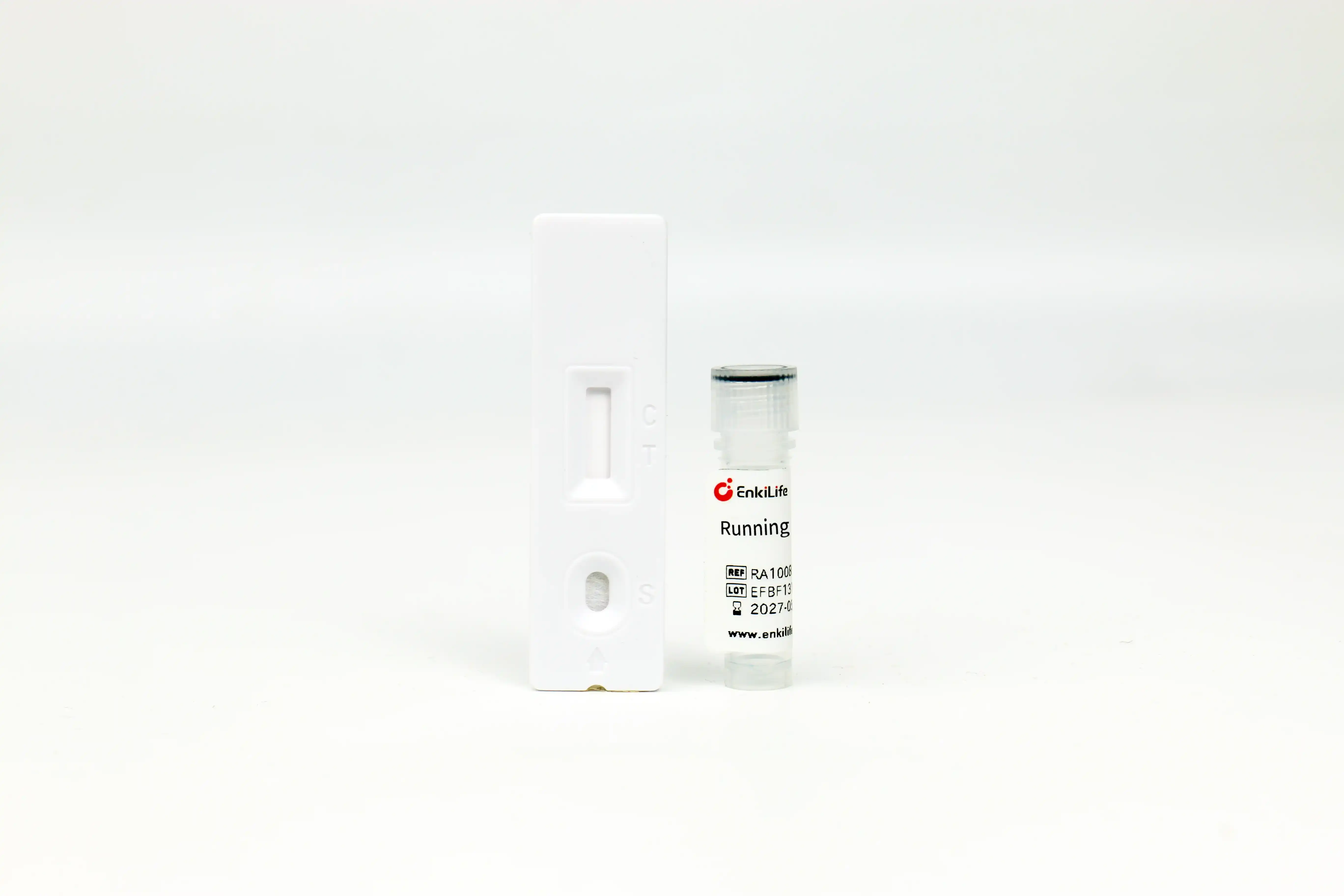


His-Tag Rapid Competitive Assay Kit
High-sensitivity Detection for His-tagged Protein · Results in 15 min · Latex Microsphere Labeled
Product Overview
His-Tag Rapid Competitive Assay Kit adopts latex microsphere immunochromatography based on competitive immunoassay principle. Red latex microspheres are used as labeling material to deliver sharp bands and low background. Recombinant His-Tag protein is immobilized as Test line, DNP-BSA as Control line; conjugate pad is coated with latex-labeled anti-His monoclonal antibody and latex-labeled DNP-BSA.
If His-Tag protein exists in sample, target antigen preferentially binds to labeled antibody and blocks its combination with immobilized antigen. Higher protein concentration leads to fainter test band. Detection range: 1~25μg/mL, CV ≤15% for repeatability, relative accuracy deviation within ±15%, providing reliable semi-quantitative test results.
Key Advantages
Time Comparison with Conventional Methods
Shorten detection period from days down to only 20 minutes!
Product Information
| Cat.No. | Specification | Storage | Shelf Life |
|---|---|---|---|
| RA10081 | 10 Tests | Sealed & Dry at RT | 12 Months |
| RA10081 | 50 Tests | Sealed & Dry at RT | 12 Months |
Components: Individually foil-packed His-Tag test cards, running buffer, detailed instruction manual
Wide Applications
- Recombinant clone screening: Rapid screening of high-expression positive transformants to save unnecessary experimental cost.
- Induction condition optimization: Compare expression under varied temperature, time and inducer concentrations rapidly.
- Purification tracking: Real-time detection of target protein in loading, flow-through and eluate fractions.
- Transfection efficiency assay: Evaluate different transfection reagents and experimental protocols conveniently.
- Protein QC verification: Confirm tag integrity for subsequent functional research.
- Industrial production QC: Intermediate testing for recombinant biologic drugs and industrial enzymes.
Operating Procedure
- Preparation: Take test card from foil pouch and lay flat; equilibrate refrigerated samples to ambient temperature.
- Sample Pretreatment: Transfer 80μL running buffer into tube, add 20μL sample and vortex for 10s.
- Sample Loading: Pipette 70μL mixed solution into sample well slowly.
- Result Reading: Incubate 15min at room temperature before recording data.
Dilution Guide: Dilute known-concentration samples to ~5μg/mL; dilute unknown prokaryotic samples 25-fold, eukaryotic samples 5-fold; adjust dilution if beyond linear range.
Low-abundance Tip: Undiluted raw sample can be used; always run identical matrix negative control for band comparison.
Result Interpretation
Both Control(C) and Test(T) develop red bands with identical intensity vs negative control; no His-Tag or concentration below 1μg/mL LOD.
Control(C) shows red band while Test(T) is absent or markedly weaker than control; paler T band means higher His-Tag concentration.
No red band on Control(C) regardless of Test(T); invalid caused by expired reagent, wrong operation or insufficient sample volume.
Compatible Common Reagents
Good tolerance to regular lab buffers, direct testing without extra sample treatment.
| Reagent Name | Max Concentration |
|---|---|
| NaCl | 0.5M |
| KCl | 0.5M |
| Urea | 0.4M |
| Triton X-100 | 1% |
| Tween-20 | 1% |
| Imidazole | 2.5M |
| Reagent Name | Max Concentration |
|---|---|
| NP-40 | 1% |
| CHAPS | 1% |
| SDS | 0.2% |
| EDTA | 5mM |
| Glycerol | 10% |
| RIPA | 100% |
Precautions
- For research only, forbidden for human clinical diagnosis or therapy.
- Single-use product, do not reuse test cards.
- Semi-quantitative kit, not for absolute precise quantification.
- Keep stationary during incubation without shaking.
- Never mix components from different production batches.
- Use buffer and test strips immediately after opening package.
- Discard experimental waste per laboratory biosafety standards.
Troubleshooting
| Phenomenon | Possible Causes | Solutions |
|---|---|---|
| No obvious T line fading vs negative control | No target protein; concentration below detection limit | Verify vector matching; test undiluted sample with negative control |
| Faint or fully missing Test band | Concentration exceeds upper working limit; complete competitive inhibition | Dilute sample at higher fold and retest |
| No Control band | Misoperation; expired; improper storage; insufficient sample | Follow manual strictly; replace new card; store sealed dry; load exact 70μL sample |